Quiet by Design: Why Acoustic Privacy Belongs at the Foundation of Every Luxury Bathroom
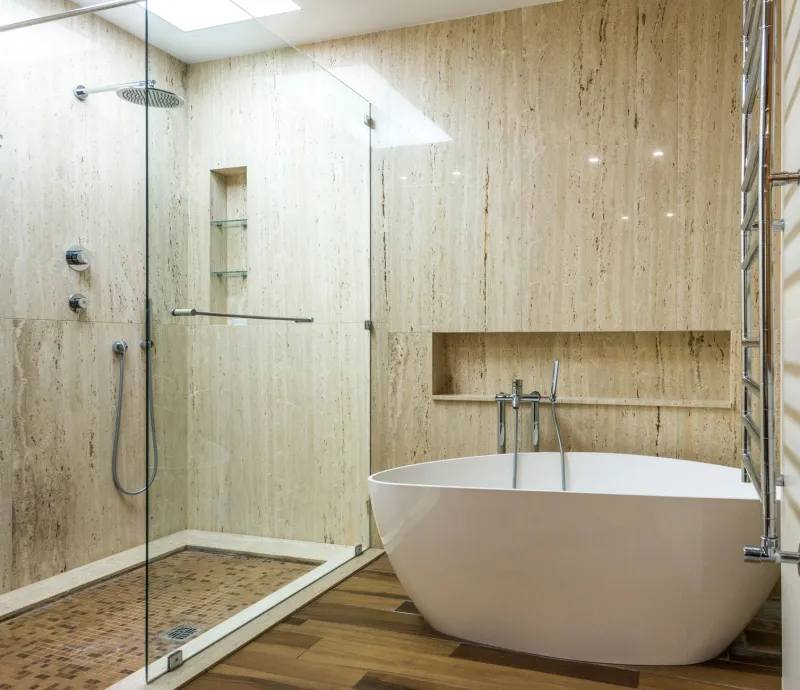
There is a particular kind of disappointment that arrives only after a renovation is complete. The marble is flawless. The freestanding tub commands the room exactly as the rendering promised. The lighting layers flatter everything they touch. And yet, the moment a door closes somewhere down the hall, or a pipe groans behind the wall, the illusion of sanctuary collapses entirely.
This is the acoustic problem in luxury bathroom design—and it is far more common than most homeowners expect. Soundproofing, despite its foundational importance, tends to be treated as an afterthought. It is the element that gets value-engineered away when budgets tighten, or simply never considered because it produces no visible result. You cannot photograph silence. You cannot showcase it at an open house. But you will feel its absence every single morning.
Why Sound Undermines the Luxury Experience More Than Any Visual Flaw
Research in environmental psychology consistently demonstrates that auditory intrusion disrupts relaxation more rapidly and more profoundly than visual imperfection. A hairline grout inconsistency goes unnoticed after a few weeks of living with a space. An unwanted sound—a neighbor's television, a gurgling drain stack, the mechanical hum of a forced-air system—registers every time it occurs. The brain cannot habituate to unpredictable auditory stimuli the way it normalizes static visual information.
For context, a typical residential hallway conversation registers between 55 and 65 decibels. Plumbing noise within walls can reach 70 decibels or higher, particularly in older construction or in homes where cast-iron drain pipes have been replaced with PVC without acoustic wrapping. The threshold at which sound begins to interfere with a relaxed physiological state sits around 45 decibels. That gap—between what most bathrooms permit and what genuine relaxation requires—is precisely where acoustic design must operate.
The affluent homeowners most likely to invest in radiant floor heating, steam generators, and programmable chromotherapy lighting are often the same individuals who have never been asked, by their designer or contractor, what they want the room to sound like.
The Three Layers Where Sound Enters and Must Be Stopped
Achieving meaningful acoustic privacy in a bathroom renovation requires addressing three distinct transmission pathways: airborne sound, impact sound, and structure-borne vibration. Each demands a different solution, and each must be planned before the walls close.
Airborne sound—voices, music, ambient household noise—travels through air gaps and insufficiently dense wall assemblies. The remedy begins with insulation. Standard fiberglass batt insulation, while thermally adequate, performs poorly as an acoustic barrier. Mineral wool insulation, sold under brand names such as Rockwool and Owens Corning's QuietZone line, offers substantially superior sound attenuation and is rated for use in wet environments. Installed within the wall cavity between a bathroom and an adjacent bedroom or corridor, mineral wool can reduce sound transmission by 15 to 25 decibels—a difference that is not subtle.
Beyond insulation, mass matters. Doubling the drywall on bathroom walls—particularly using a product like QuietRock, a damped drywall engineered specifically for acoustic control—adds meaningful mass without requiring structural modification. Acoustic sealant applied at all penetrations, electrical boxes, and plate intersections closes the small gaps that standard construction routinely ignores.
Impact sound is the transmission of vibration through solid materials: footsteps on the floor above, objects placed on a vanity surface, the mechanical thud of a toilet seat. Underlayment systems beneath tile installations—products like SCHLUTER-DITRA-SOUND or cork-based membranes—decouple the finished floor from the subfloor, interrupting the path that impact energy would otherwise travel through the building structure. This consideration is especially relevant in multi-story homes and high-rise residences where bathroom floors sit above living spaces.
Structure-borne vibration from plumbing is perhaps the most overlooked category. When water moves through pipes at high velocity, and when pipes are rigidly fastened to framing, the vibration transfers directly into walls and floors. Acoustic pipe wrapping—closed-cell foam products applied around drain lines—combined with rubber isolation brackets that prevent direct pipe-to-framing contact, can reduce plumbing noise by a significant margin. This work must happen before walls are closed. Once the drywall is in place, the opportunity is gone.
Fixture Selection as an Acoustic Decision
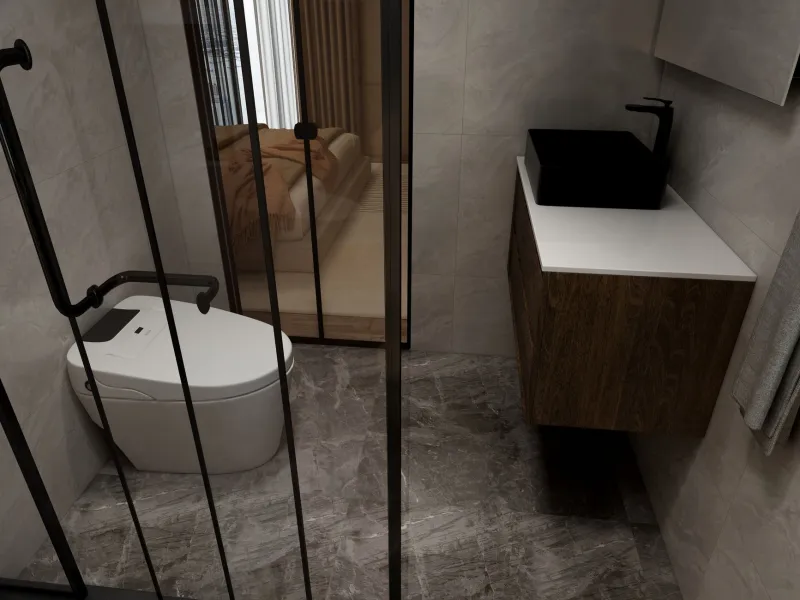
The fixtures specified for a luxury bathroom are not only aesthetic choices—they are acoustic ones. Wall-hung toilets with in-wall tank systems are considerably quieter than floor-mounted models because the cistern is housed within the wall cavity, muffled by whatever insulation surrounds it. Many designers recommend them for precisely this reason, quite apart from their clean visual profile.
Faucet and showerhead selection also carries acoustic implications. High-pressure fixtures with turbulent flow patterns generate more noise than those designed for laminar, aerated water delivery. A rain shower head positioned overhead and calibrated to deliver water in a smooth, consistent sheet creates a fundamentally different acoustic environment than a multi-function body spray system operating at maximum pressure.
For homeowners installing soaking tubs or steam showers, the mechanical components—pumps, generators, exhaust fans—deserve careful acoustic specification. Exhaust fans, in particular, are among the most common sources of chronic bathroom noise. Units rated below 1.0 sones, such as those offered by Panasonic's WhisperSense series or Broan's Ultra Silent line, operate at levels that are genuinely inaudible during normal use.
Integrating Acoustic Solutions Without Compromising Design
The concern most frequently raised by homeowners and designers alike is that acoustic treatment will impose limitations on the visual program of the space. In practice, the opposite is often true. The solutions described above—mineral wool insulation, damped drywall, acoustic underlayment, pipe wrapping—are entirely concealed within the construction assembly. They impose no aesthetic constraint whatsoever.
Where acoustic treatment does become visible, it can be designed with intention. Fabric wall panels, for instance, absorb mid-to-high-frequency sound and are available in materials appropriate for humid environments. Integrated into a feature wall or positioned behind a built-in headboard in a bathroom suite, they contribute meaningfully to sound absorption while functioning as a deliberate design element.
Soft furnishings—bath mats, upholstered seating, window treatments with substantial fabric weight—all absorb sound energy that would otherwise reflect off hard tile and stone surfaces. The highly reflective material palette that defines contemporary luxury bathrooms is, from an acoustic standpoint, a challenging environment. Deliberate introduction of absorptive surfaces brings the room into balance.
The Conversation to Have Before Demolition Begins
For any homeowner preparing to undertake a serious bathroom renovation, acoustic privacy deserves its own line item in the design brief—not a footnote. The question to raise with your architect or design-build team is straightforward: what is the acoustic separation strategy for this space, and how will it be implemented in the wall, floor, and ceiling assemblies before they are closed?
If the answer is vague, or if the topic has never been raised, that is important information. The most exquisite bathroom is only as luxurious as the experience it delivers in daily use. And a space that cannot protect its occupants from the sounds of the surrounding household is not, by any honest measure, a sanctuary.
Silence, it turns out, is not the absence of design. It is among its most demanding expressions.