Spending Smart: Which Bathroom Renovations Actually Influence Sale Price—And Which Ones Only Impress You
The Assumption Worth Questioning
There is a persistent belief among homeowners undertaking luxury bathroom renovations that premium investment naturally yields premium return. The logic seems intuitive: spend more, recoup more. Yet the relationship between high-end bathroom expenditure and actual resale value is considerably more nuanced—and, in some cases, considerably more humbling—than most renovation guides care to acknowledge.
The reality is that buyer perception, regional market dynamics, and the practical expectations of prospective purchasers often diverge sharply from the aesthetic ambitions of current owners. Understanding that gap is not a reason to forgo luxury finishes; it is, however, a compelling reason to choose them with greater strategic clarity.
What the Data Consistently Shows
According to Remodeling Magazine's Cost vs. Value Report, midrange bathroom remodels in the United States have historically returned somewhere between 60 and 70 percent of their cost at resale—a figure that sounds reasonable until you consider that upscale bathroom renovations frequently return less, often hovering closer to 55 percent. The paradox is real: the more you spend, the lower your percentage return tends to be.
This does not mean luxury renovations are financially reckless. It means the calculation requires more precision. Certain elements command broad buyer appeal and reliably support asking prices. Others represent deeply personal choices that a seller may love and a buyer may simply tolerate.
The distinction matters enormously when you are deciding where to allocate a renovation budget.
The Fixtures That Actually Move Buyers
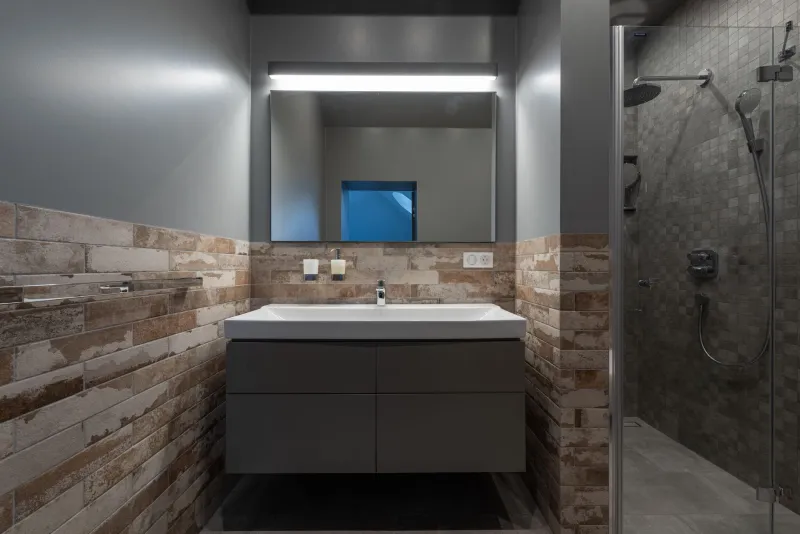
Among the upgrades that consistently register with buyers across American markets, walk-in showers with frameless glass enclosures rank near the top. Their appeal is both visual and practical: they read as modern, they are relatively easy to maintain, and they photograph well—a factor that has grown in importance as online listing searches now represent the majority of first impressions.
Double vanities similarly generate broad enthusiasm, particularly in primary bathrooms serving couples or families. This is less about the vanity material itself and more about the functional logic it communicates: two sinks signal thoughtful design, and thoughtful design signals quality throughout the home.
Updated plumbing fixtures—particularly matte black and brushed nickel finishes—have demonstrated staying power in buyer preference research, largely because they read as contemporary without appearing trend-dependent. Buyers respond to coherence. When fixtures feel intentionally coordinated, the bathroom communicates professionalism and care.
Finally, and perhaps most importantly: lighting. Layered lighting with well-placed vanity illumination consistently influences buyer perception in ways that are disproportionate to its cost. A bathroom that photographs brightly and feels welcoming during a showing has a measurable psychological advantage over a technically superior space that reads as dim or clinical.
The Premium Finishes That Primarily Serve the Owner
This is where the conversation becomes more candid. Certain luxury elements that homeowners find deeply satisfying have a limited ability to shift a buyer's offer upward in most American markets.
Hand-cut mosaic tile, while genuinely exquisite, often registers to buyers as a maintenance concern rather than a luxury feature. Unless the home is positioned in a market where buyers have prior experience with artisan materials—certain coastal markets, high-density urban centers, or resort communities—its value is frequently absorbed rather than rewarded.
Radiant floor heating is a similar case. Owners who have experienced it consider it transformative. Buyers who have not often struggle to assign it a dollar figure, particularly in warmer climates where the feature feels less relevant. In Minneapolis or Chicago, radiant floors carry more persuasive weight than they do in Miami or Phoenix.
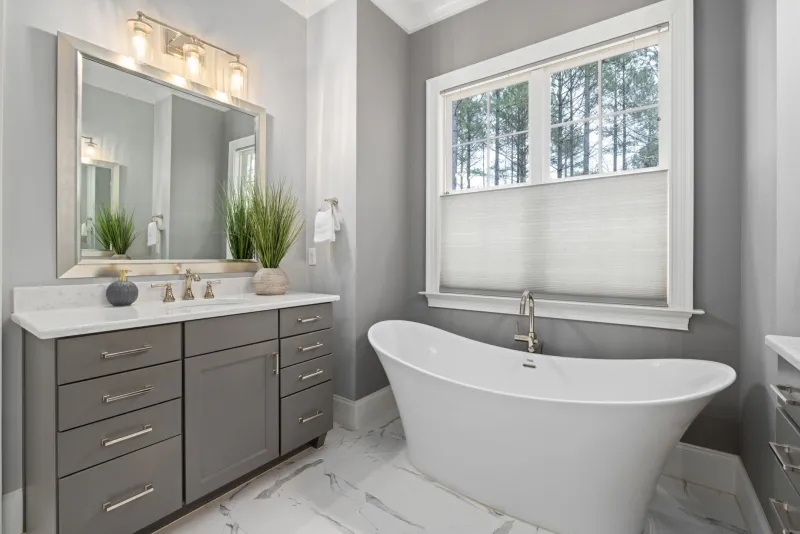
Statement soaking tubs—freestanding sculptural pieces that anchor a bathroom visually—represent perhaps the clearest illustration of personal preference versus market preference. In homes priced above $1.5 million in competitive urban and suburban markets, a well-chosen freestanding tub can support the overall luxury narrative. Below that price point, or in markets where buyers prioritize shower functionality over bathing ritual, the tub may generate admiration during a showing without generating additional dollars in an offer.
Regional Variation Is Not a Footnote—It Is the Story
Any honest analysis of bathroom renovation ROI must contend with the fact that the United States is not a single real estate market. It is hundreds of overlapping markets with distinct buyer profiles, climate considerations, and price-per-square-foot realities.
In the Pacific Northwest, natural stone and wood-adjacent materials tend to resonate with buyers who have a cultural affinity for organic design. In the Sun Belt, clean lines, light palettes, and water-efficient fixtures frequently outperform darker, more material-intensive designs. In the Northeast, particularly in older housing stock, buyers often respond strongly to renovations that signal structural integrity—updated plumbing, properly waterproofed wet areas, and quality tile installation—as much as they respond to aesthetic choices.
Before committing to a renovation strategy, understanding your specific market's buyer expectations is not optional. It is the foundation of a financially responsible decision.
The Framework for Smarter Renovation Decisions
Rather than approaching a bathroom renovation as either a personal indulgence or a purely financial calculation, the most strategically sound approach treats it as both—with clear eyes about which decisions serve which purpose.
Begin with the fundamentals that buyers universally notice: updated fixtures, functional lighting, clean lines, and quality tile installation. These elements form the baseline of a bathroom that reads as premium without depending on a buyer's personal taste to appreciate them.
Layer in personal preferences—the soaking tub, the heated floors, the handcrafted tile—with the understanding that these choices may enrich your daily life significantly while contributing modestly to your eventual sale price. That is not a poor investment. It is simply a different kind of investment, one measured in daily satisfaction rather than percentage return.
Finally, consult a local real estate professional before finalizing any renovation plan with resale as a meaningful consideration. National averages are useful context; local market intelligence is actionable guidance.
The Honest Calculus
Luxury bathroom design, at its best, represents a genuine commitment to how a home feels to inhabit. The finest materials, the most considered layouts, and the most thoughtfully selected fixtures create spaces that improve daily life in ways that are difficult to quantify and easy to underestimate.
But conflating personal enrichment with financial return is a mistake that costs homeowners real money. The bathroom that makes you happiest every morning may not be the bathroom that makes a buyer reach higher on an offer. Knowing the difference—and designing accordingly—is what separates a renovation made with wisdom from one made with wishful thinking.