The Presence of Water: How Strategic Placement of Aquatic Elements Redefines Bathroom Wellness
There is a particular stillness that settles over a person who stands near moving water. It is not the stillness of inactivity—it is the stillness of a nervous system that has, quite involuntarily, begun to decompress. Neuroscientists have documented this phenomenon at length, and resort designers have exploited it for decades. Yet in the domain of residential bathroom design, the conversation about water wellness has remained stubbornly narrow, focused almost exclusively on the fixtures one enters: the soaking tub, the rainfall showerhead, the steam enclosure.
The most sophisticated luxury bathrooms being designed today take a fundamentally different view. They treat water not merely as a utility or even a bathing medium, but as an environmental element—something to be heard, seen, and felt in the air before a single fixture is ever engaged. The result is a category of space that functions less like an upgraded bathroom and more like a private wellness pavilion.
The Psychology of Water Proximity
Research into what marine biologist Wallace J. Nichols famously termed the "blue mind" state offers a compelling framework for understanding why proximity to water—independent of contact with it—produces measurable psychological benefit. Exposure to water environments, even visual or acoustic exposure, has been associated with reduced cortisol levels, lowered heart rate, and a shift toward the parasympathetic nervous system responses commonly associated with rest and recovery.
For bathroom designers, this research carries a direct implication: a cascading wall feature positioned within the sightline of a vanity mirror, or a shallow reflection basin placed at the threshold of a wet room, begins its therapeutic work the moment a person enters the room. The soaking tub need not be filled. The shower need not be running. The environment itself is already performing.
This is the foundational principle behind what leading designers are now calling the "ambient water" approach—the deliberate choreography of water's presence throughout a bathroom environment, rather than its concentration within a single fixture.
Japanese Design Philosophy and the Concept of Ma
No design tradition has thought more carefully about the relationship between water, space, and human experience than the Japanese. The concept of ma—often translated as negative space or meaningful interval—is central to Japanese spatial philosophy, and it applies with particular resonance to water's role in the bathroom environment.
In the traditional Japanese ofuro bathing culture, the act of bathing is preceded by a period of transition: rinsing, stillness, a gradual psychological shift from the outside world to the interior one. Water is present throughout this transition, not just at its culmination. The sound of water filling a deep cedar tub, the sight of steam rising in a tiled anteroom, the sensation of humidity in the air—all of these precede immersion and are considered integral to the restorative experience.
Luxury bathroom designers in the United States are increasingly drawing on this tradition, not through direct imitation, but through a shared commitment to the idea that the approach to water is as important as water itself. A narrow channel of still water running along the base of a stone wall, a wall-mounted spout that feeds a shallow basin before draining away quietly, a fogged glass panel behind which water moves in slow, visible currents—these are the spatial gestures that transform a bathroom from a room with fixtures into an environment with intention.
What Resort Architecture Understands That Residential Design Often Misses
Spend time at any world-class spa resort—whether in Scottsdale, coastal Maine, or the hills of Napa Valley—and the spatial logic becomes immediately apparent. Water is never confined to the treatment room. It greets guests at the entrance, lines the corridors, anchors the courtyards. Its sound is calibrated. Its visual movement is considered. By the time a guest reaches the treatment itself, the nervous system has already been prepared.
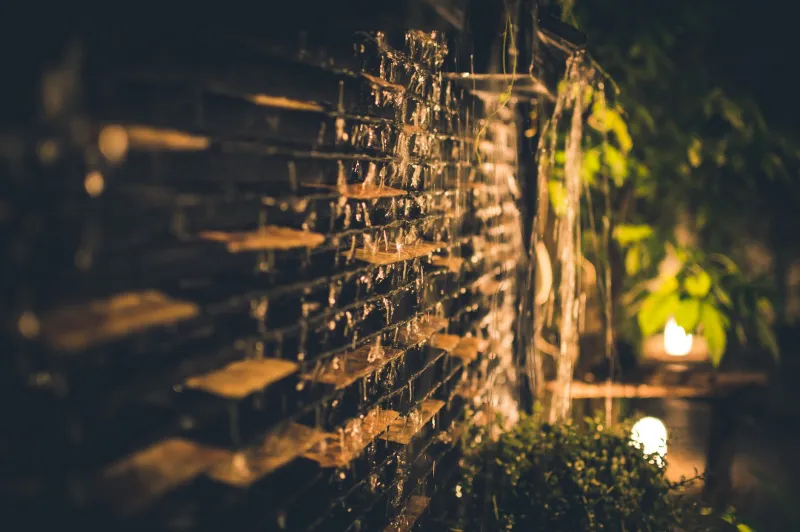
This is deliberate environmental design, and it is precisely what the finest residential bathrooms are now beginning to replicate at an intimate scale. A freestanding water wall adjacent to the vanity area. A narrow lap feature built into the base of a window bench. A recessed niche in which water moves slowly across river stones, its sound just audible above the ambient quiet of the room. None of these elements require the homeowner to interact with them directly. They simply alter the character of the space.
The acoustic dimension deserves particular attention. The sound of moving water operates at frequencies that research consistently associates with relaxation responses. Unlike white noise—which is uniform and mechanical—the sound of natural water movement is irregular, layered, and biologically familiar. A well-positioned cascading feature introduces this quality into a bathroom environment without overpowering it, creating what acoustic designers sometimes describe as a "soft floor" of sound on which the silence of the room can rest.
Practical Considerations for the American Luxury Bathroom
Implementing an ambient water strategy in a residential bathroom requires careful coordination between the design vision and the technical realities of plumbing, waterproofing, and maintenance. Several considerations are worth addressing directly.
Scale and proportion matter enormously. A water feature that is too large for its environment will dominate rather than complement, producing anxiety rather than calm. In most residential bathrooms, even generously sized ones, subtlety is the operative principle. A feature that can be heard before it is fully seen is typically better calibrated than one that announces itself visually from across the room.
Recirculating systems are the standard approach for decorative water features in residential settings. They require a dedicated water supply and drain connection, a pump, and a filtration mechanism. A licensed plumber with experience in decorative water installations should be engaged from the earliest planning stages, as the structural and waterproofing requirements will influence decisions about wall construction, flooring, and cabinetry.
Maintenance protocols must be established in advance. Standing or slow-moving water in a residential environment requires consistent attention to prevent mineral buildup and microbial growth. Many homeowners find that automated dosing systems, similar to those used in small fountain installations, manage this effectively with minimal ongoing effort.
Lighting is the essential partner to water. The visual quality of a water feature changes dramatically depending on how it is lit. Warm, low-angle lighting emphasizes movement and texture. Cooler, diffuse lighting enhances the reflective quality of still water. A well-designed water feature without considered lighting is a missed opportunity; together, they produce the kind of visual depth that photographs cannot fully capture.
Designing for the Space Between
The most enduring luxury bathrooms are not defined by any single fixture or material, but by the quality of experience they produce across the full arc of a visit—from the moment of entry to the moment of departure. Water, understood as an environmental element rather than simply a utility, is among the most powerful tools available for shaping that experience.
The spa effect, properly understood, is not about replicating the amenities of a resort. It is about borrowing the spatial intelligence that resorts have developed over decades of studying how human beings respond to their environments. Water placed with intention—seen, heard, and sensed in the air—accomplishes something that even the finest plumbing fixture cannot: it changes the room before you have done anything at all.