When Luxury Becomes Liability: The Hidden Cost of Skipping Professional Commissioning in High-End Bathroom Installations
There is a particular kind of disappointment that arrives not during a renovation, but after it. The tile is flawless. The steam shower is imported. The radiant floor heating cost more than some families spend on a vacation. And yet, on the morning the homeowner steps into their newly completed sanctuary for the first time, something is wrong. The steam generator cycles erratically. The smart mirror refuses to sync. The heated floor runs at a single, unvarying temperature regardless of what the control panel suggests. The luxury, in every meaningful sense, has not arrived.
This scenario is far more common than the industry publicly acknowledges. As bathroom systems grow increasingly sophisticated—layering smart controls, hydronic heating, steam generation, chromotherapy lighting, and digitally integrated fixtures into a single cohesive environment—the gap between a beautiful installation and a fully functional one has widened considerably. Bridging that gap is the work of professional commissioning, a discipline that remains chronically undervalued by homeowners and, at times, inadequately communicated by contractors.
What Commissioning Actually Means
In the context of a luxury bathroom, commissioning refers to the structured process of verifying, calibrating, and integrating every installed system so that it performs according to its design specifications—not merely according to the installer's best guess. It is distinct from installation itself. A plumber can correctly connect a steam generator to its water supply and still leave the unit improperly configured for the room's cubic footage, the local water mineral content, or the specific ventilation conditions of the space.
Commissioning addresses the interface between components: how the smart home hub communicates with the thermostatic valve, how the exhaust fan responds to humidity sensors, how the radiant heating zones are balanced against one another. It is, in essence, the process of making a collection of expensive parts behave as a unified, intelligent system.
For bathrooms below a certain complexity threshold, this step is sometimes optional in practice, if not in principle. For a bathroom incorporating steam, programmable water delivery, motorized privacy glass, integrated audio, and multi-zone radiant heating, it is not optional at all. It is the difference between a functional luxury space and an expensive source of ongoing frustration.
The Anatomy of a High-End Failure
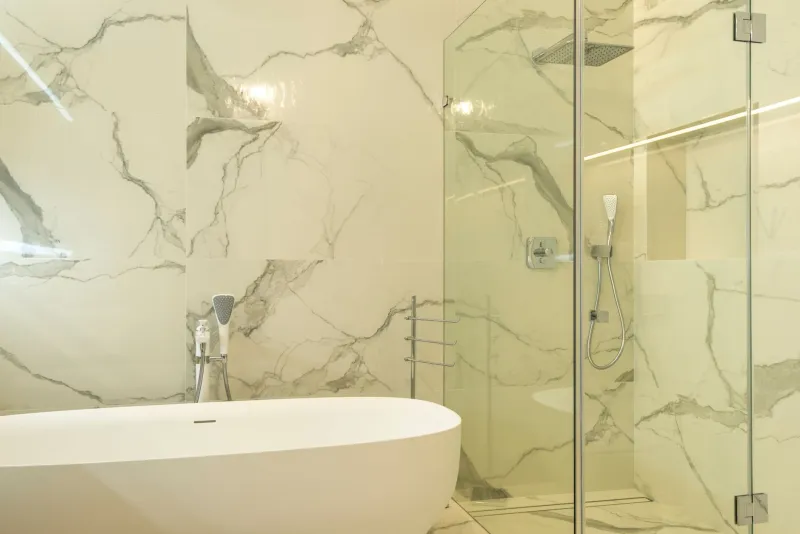
Consider a renovation completed in suburban Chicago several years ago. The homeowners had invested approximately $340,000 in a primary bathroom that included a digital shower system with body sprays and an overhead rain panel, a freestanding soaking tub with an inline water heater, a steam enclosure, and full smart-home integration. The general contractor coordinated the trades competently. The tile work was exceptional. The fixtures were from a respected European manufacturer.
What no one had arranged was a commissioning session with a technician certified in the shower system's digital platform. The result: the body sprays and rain panel could not be operated simultaneously at their intended pressures because the supply line had been sized for one or the other, not both. The inline tub heater was set at its factory default temperature, which the homeowners found uncomfortably low. The steam generator's auto-flush cycle had never been configured, leading to mineral accumulation that required a service call within fourteen months. None of these failures were the fault of any individual tradesperson. They were the predictable consequence of a system that was installed but never commissioned.
Common Commissioning Failures by System Type
Steam Systems Steam generators are among the most technically demanding elements in any luxury bathroom. Proper commissioning requires calibrating output to room volume, verifying that the steam head is positioned for optimal distribution, confirming that the auto-drain and flush cycles are programmed, and—critically—accounting for local water hardness. In regions with hard water, an improperly commissioned generator will accumulate scale at a rate that dramatically shortens its service life. A unit that should last fifteen years may require replacement in five.
Thermostatic and Digital Shower Systems High-end thermostatic valves from manufacturers such as Kohler, Hansgrohe, and Moen's smart product lines require calibration to the home's specific water pressure and temperature delivery conditions. Factory defaults are designed for average conditions. A home with higher-than-average supply pressure, or one served by a tankless water heater with a particular flow rate, will behave differently from what the factory anticipated. Without adjustment, the experience of using the shower can diverge substantially from what was promised in the showroom.
Radiant Heating Hydronic and electric radiant systems both require balancing and zone calibration. A bathroom with multiple heated zones—floor, towel warming, and a supplemental panel—needs those zones coordinated so that they do not work against one another. An improperly balanced system can result in uneven floor temperatures, excessive energy consumption, or a thermostat that cycles so frequently it never achieves the target warmth.
Smart Integration The promise of the fully integrated bathroom—one where a single interface controls lighting, temperature, music, mirror display, and water delivery—is genuinely achievable. However, it depends entirely on the commissioning of the software layer. Devices from different manufacturers must be mapped, paired, and tested. Scenes must be programmed. Fail-states must be defined. This work is invisible when done correctly and maddening when omitted.
A Practical Commissioning Checklist
For homeowners preparing to complete a luxury bathroom renovation, the following framework represents a minimum standard of due diligence:
-
Identify the commissioning requirement during the design phase, not after installation. Every major system should have a designated commissioning authority—either the manufacturer's certified technician or a qualified systems integrator.
-
Request documentation of all factory defaults for each installed system, and confirm in writing which settings will be adjusted during commissioning.
-
Schedule commissioning as a separate appointment, distinct from the final walkthrough with the general contractor. These are not the same thing.
-
Test every scene and every combination of simultaneous use. A steam shower and the floor heating running concurrently. The rain panel and body sprays together. The smart mirror and the audio system on the same circuit.
-
Obtain calibration records for thermostatic valves, radiant zones, and steam output. These documents are valuable for future service calls.
-
Confirm warranty activation for each major system. Many manufacturer warranties require professional commissioning as a condition of coverage. Skipping this step can void the warranty on a $15,000 steam generator.
-
Schedule a thirty-day follow-up with the commissioning technician. Real-world use reveals issues that bench testing does not.
The Broader Principle
There is a tendency, understandable in the context of a long and expensive renovation, to treat the physical completion of a bathroom as the finish line. Tiles grouted, fixtures hung, doors rehung—done. But a luxury bathroom is not a static object. It is a system of interrelated technologies, and systems require configuration.
The homeowners who derive the full value of their investment are, almost without exception, those who treat commissioning as a non-negotiable line item rather than an optional afterthought. The cost of professional commissioning—typically ranging from $1,500 to $6,000 depending on system complexity—is modest relative to the installation it protects. The cost of skipping it, measured in service calls, warranty disputes, diminished performance, and the quiet erosion of a space that was supposed to feel extraordinary, is invariably higher.
Luxury, properly understood, is not merely about what is installed. It is about how reliably and beautifully it performs. That performance begins not at installation, but at commissioning.