Sanctuary Within the Open House: How Luxury Bathrooms Are Mastering the Art of Absolute Privacy
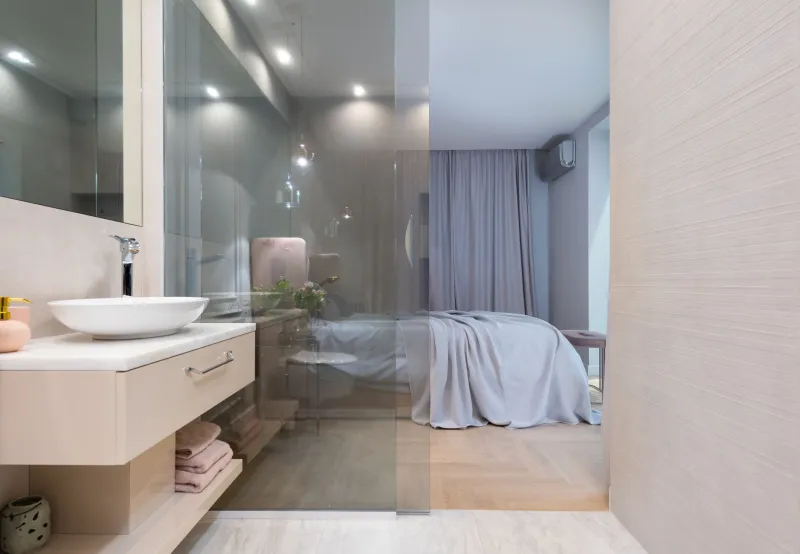
There is a quiet irony embedded in the modern luxury home. The same architectural philosophy that tears down walls between kitchen, dining, and living spaces—celebrating openness, flow, and communal living—has simultaneously elevated the bathroom to something it has never quite been before: the last truly private room in the house.
For affluent American homeowners, this tension is not merely aesthetic. It is a design problem that demands serious, considered resolution. As open-plan living has migrated from urban lofts to suburban estates and coastal retreats, the bathroom has become the singular space where privacy is not just expected but architecturally engineered. And the investment required to do it well has grown accordingly.
The New Definition of Bathroom Privacy
Privacy, in the context of a luxury bathroom, extends well beyond a locked door. Contemporary high-end design treats privacy as a layered condition—one that encompasses visual separation, acoustic isolation, olfactory control, and even the subtler psychological comfort of feeling genuinely removed from the rest of the household.
This expanded definition has reshaped how architects and interior designers approach bathroom placement, material selection, and mechanical systems from the earliest stages of a project. A bathroom that is merely difficult to see into is no longer sufficient. The modern luxury standard demands a space that cannot be heard, smelled, or sensed from adjacent rooms—a room that, in the most literal terms, disappears from the consciousness of the home's other occupants.
Strategic Placement: The Architecture of Separation
The most effective privacy interventions begin long before a single fixture is selected. Architects working on high-end residential projects increasingly treat bathroom placement as a primary planning consideration rather than an afterthought.
Buffer zones—transitional spaces such as dressing rooms, walk-in closets, or vestibules positioned between the bedroom and the bathroom proper—have become a hallmark of thoughtfully designed luxury primary suites. These intermediate spaces serve multiple functions simultaneously: they absorb sound, create physical distance from sleeping areas, and establish a deliberate sense of arrival that reinforces the bathroom's identity as a destination rather than a utility.
Corner placements and rooms positioned away from high-traffic corridors are similarly favored. Where structural constraints limit options, designers often introduce angled entry sequences—approaches that prevent direct sightlines into the bathroom interior even when the door is ajar.
Acoustic Engineering as a Privacy Tool
Sound transmission remains one of the most underestimated dimensions of bathroom privacy, and one of the most technically demanding to address. In open-plan homes, where hard surfaces proliferate and sound travels freely across large volumes of space, the acoustic performance of a bathroom enclosure requires deliberate engineering.
Double-stud wall construction—in which two independent wall frames are built with an air gap between them—significantly reduces the transfer of airborne sound. Resilient channel systems, which mechanically decouple drywall from structural framing, add another layer of attenuation. Acoustic insulation batts, distinct from standard thermal insulation, are specified within wall cavities to absorb sound energy before it can propagate.
Doors warrant equal attention. Solid-core doors with proper acoustic seals at the threshold and perimeter perform dramatically better than hollow-core alternatives. Some designers specify doors with sound transmission class ratings typically associated with commercial construction—a detail that signals a genuine commitment to the standard of privacy being pursued.
Mechanical systems represent a less obvious but equally important acoustic consideration. High-quality exhaust fans with low sone ratings eliminate the disruptive hum that cheaper units produce, while also preventing sound from migrating through ductwork into adjacent spaces.
Glass Innovations: Transparency on Demand
Few design elements capture the privacy paradox of the contemporary luxury bathroom more precisely than electrochromic glass—a technology that has migrated from commercial architecture into the residential realm with considerable momentum.
Electrochromic, or switchable, glass transitions between transparent and opaque states at the touch of a control, allowing homeowners to calibrate their degree of visual exposure in real time. In primary bathrooms where expansive glazing is desirable for natural light or garden views, this technology resolves what would otherwise be an irreconcilable conflict between openness and seclusion.
For homeowners who prefer a more traditional approach, advanced acid-etched and sandblasted glass panels offer sophisticated alternatives to standard frosted glass. These treatments can be applied with varying degrees of opacity across a single panel, creating gradient effects that allow light to pass freely while obscuring the human form. Reeded and fluted glass, which has experienced a significant resurgence in high-end design, provides a similar function with a distinctly artisanal character.
Internal glazing—glass used within the bathroom itself to separate the water closet from the broader suite—has become a compositional staple of luxury bathroom design. These internal partitions preserve the sense of spaciousness that homeowners invest in open layouts while maintaining the functional privacy that the space requires.
Ventilation Design and Olfactory Privacy
A dimension of bathroom privacy that rarely surfaces in design publications—yet one that experienced designers address without exception—is olfactory control. In an open-plan home, inadequate ventilation is not merely uncomfortable; it is a genuine failure of the privacy standard the space is meant to uphold.
High-performance exhaust systems, properly sized for the volume of the bathroom and positioned to capture air at the source, are non-negotiable in a luxury context. Heat recovery ventilators, which exchange stale interior air with fresh exterior air while recovering thermal energy, represent the current best practice for primary bathroom ventilation in climate-controlled homes.
Negative pressure design—configuring the bathroom's mechanical systems so that air flows into the space from adjacent rooms rather than outward—prevents odors from migrating into the broader home. This approach, borrowed from commercial restroom design, is increasingly adopted in high-end residential projects where the standard of discretion is commensurately elevated.
Privacy as Status: The Cultural Shift
Beyond the technical, there is a cultural dimension to the luxury bathroom's evolution toward privacy that merits acknowledgment. In an era defined by pervasive connectivity and the erosion of personal boundaries, the ability to construct genuine solitude has acquired a new kind of social currency.
For affluent American homeowners, the bathroom has become the room that most authentically expresses this value. The investment required to engineer true acoustic, visual, and olfactory seclusion within an otherwise open home is substantial—and increasingly, that investment is understood as a marker of sophistication rather than mere comfort.
A bathroom that is genuinely private, in every dimension the word implies, is no longer simply a functional amenity. It is a statement about how seriously a home takes the wellbeing of the people who live within it. In that sense, privacy may be the most quietly powerful luxury of all.