The Case for Cold: Why Intentional Temperature Contrast Is the Mark of a Truly Sophisticated Bathroom
There is a prevailing assumption in luxury bathroom design that comfort means warmth. Heated floors, towel warmers, steam showers, radiant ceiling panels—these have become the default vocabulary of the high-end bathroom, and for good reason. Warmth is welcoming. Warmth is indulgent. Warmth sells.
But warmth alone is not sophistication. Sophistication, as any seasoned designer will tell you, is the product of contrast. And nowhere is that principle more misunderstood—or more underutilized—than in the thermal design of luxury bathrooms.
The most compelling spaces in the world, from five-star spa facilities in Scottsdale to boutique wellness retreats in the Hudson Valley, share a quality that is difficult to articulate but immediately felt upon entry: they are not uniformly anything. They modulate. They shift. They surprise. And when it comes to temperature, the finest of them deliberately incorporate cool zones alongside warm ones—creating what designers are increasingly calling a thermally layered environment.
Why Uniform Warmth Falls Short
The instinct to heat every surface of a luxury bathroom is understandable. Cold tile underfoot on a January morning in Chicago or Minneapolis is nobody's idea of a pleasant start to the day. Radiant floor systems addressed that problem elegantly, and their adoption in high-end residential construction has been near-universal over the past decade.
The difficulty arises when warmth becomes the singular design ambition. A bathroom held at a consistent elevated temperature—floors, walls, air, fixtures—begins to feel less like a sanctuary and more like a greenhouse. The body's thermal receptors, which are exquisitely sensitive to change rather than steady states, stop registering pleasure and begin registering stasis. The environment becomes, in a word, flat.
Neurologically, this matters. Research in environmental psychology consistently demonstrates that human beings perceive comfort not as an absolute temperature but as a relationship between temperatures. The warmth of a heated floor registers as luxurious precisely because the air above it is cooler. Remove that differential, and the perception of warmth diminishes—not because the floor is any less warm, but because contrast is the mechanism through which warmth is felt.
The Role of Cool Materials in a Warm Room
This is where material selection becomes a thermal design decision, not merely an aesthetic one.
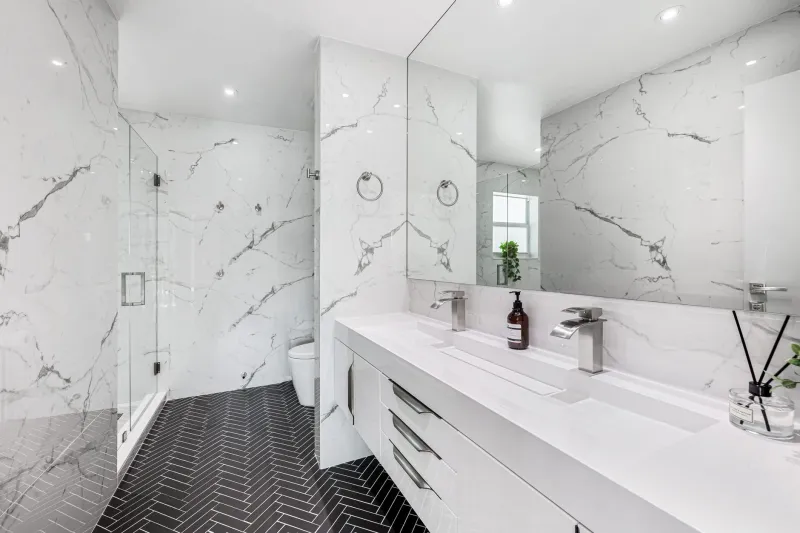
Honed Carrara marble, for instance, has a thermal conductivity that keeps its surface measurably cooler than the ambient air temperature in most bathroom environments. This is not a flaw to be engineered away—it is a feature to be exploited. A cool marble countertop beside a warm vessel sink creates a tactile dialogue that elevates both sensations. A slab of leathered quartzite on a feature wall will read several degrees cooler than the heated floor below it, grounding the body in a way that a uniformly warm room never can.
Similarly, brushed nickel and matte chrome fixtures remain cool to the touch even in steam-rich environments, offering a moment of thermal reset that feels, instinctively, clean. Designers working at the highest level are increasingly intentional about where these cool-touch moments occur within the spatial sequence of a bathroom—placing them at points of transition, such as the entry to a shower enclosure or the edge of a soaking tub surround, where the contrast is most perceptible and most meaningful.
Ventilation as Architecture
Perhaps the most overlooked dimension of thermal design in luxury bathrooms is the strategic use of ventilation to create micro-climates within a single space.
Conventional bathroom ventilation is purely functional: remove moisture, prevent mold, meet code. In a thermally layered bathroom, ventilation becomes architectural. A ceiling-mounted exhaust positioned directly above the shower zone draws warm, humid air upward and away, while a low-profile supply vent near the vanity introduces a subtle current of conditioned air that keeps that zone perceptibly fresher and cooler. The result is a bathroom that contains two distinct atmospheric conditions within the same four walls.
This approach has practical benefits that extend well beyond sensory experience. Targeted ventilation dramatically reduces the risk of condensation on mirrors and cool surfaces, extends the life of cabinetry and millwork, and improves overall air quality—a consideration that is increasingly important to health-conscious homeowners who have invested significantly in non-toxic finishes and natural materials.
For bathrooms incorporating a dedicated steam room or steam shower, the thermal zoning becomes even more pronounced. The transition from a steam environment at 110 degrees Fahrenheit to a vanity zone maintained at 68 to 72 degrees is, physiologically, a form of contrast therapy—a practice long embraced in Scandinavian wellness culture and now gaining significant traction among American wellness-oriented homeowners.
Cold Plunge and the New American Wellness Bathroom
No discussion of thermal contrast in the luxury bathroom would be complete without acknowledging the cold plunge, which has moved decisively from the realm of elite athletic recovery into residential design over the past three years. Once the exclusive province of professional sports facilities and European spa complexes, cold plunge vessels are now appearing in primary bathrooms, basement wellness suites, and outdoor-adjacent spa rooms across the country.
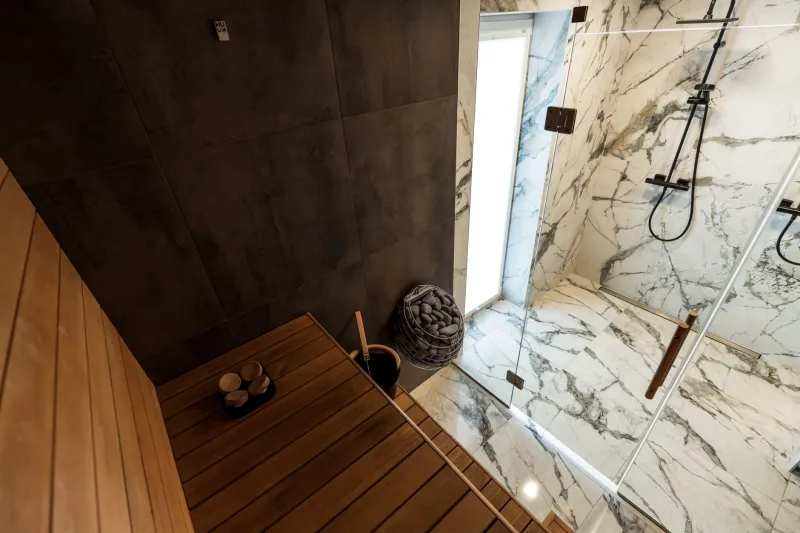
The design challenge posed by a cold plunge installation is, in essence, the challenge of thermal contrast made manifest: how do you create an environment that accommodates both the warmth of a sauna or steam shower and the deliberate cold of a plunge, without one undermining the other? The answer, consistently, is intentional separation—not physical isolation, but spatial choreography that allows each thermal zone to be fully experienced before the transition to the next.
This is luxury design thinking at its most evolved. The bathroom is no longer a room with a single temperature and a single mood. It is a sequence of experiences, each defined in part by its relationship to what preceded it.
Designing Your Own Thermal Contrast
For homeowners considering a renovation, the principles of thermal layering need not require a full cold plunge installation or a commercial-grade ventilation overhaul. The approach scales gracefully.
At the material level, resist the impulse to warm every surface. Allow cool stone, cool metal, and cool glass to coexist with heated floors and warmed towel rails. Let the contrast do its work.
At the systems level, consult with your HVAC designer about zoned ventilation that treats the shower area, the vanity area, and any soaking tub niche as distinct micro-climates rather than a single undifferentiated volume.
And at the experiential level, consider the sequence of your bathroom. Where do you enter? Where do you linger? Where do you transition? Design the thermal gradient to follow that sequence, so that warmth is encountered when it is most welcome and coolness arrives precisely when it is most refreshing.
The luxury bathroom has always been about more than function. At its best, it is a space that understands the body—its rhythms, its preferences, its capacity for pleasure. And the body, it turns out, does not want to be uniformly warm. It wants to feel the difference.