Beyond Warm Floors: How Precision Temperature Control Has Become the Defining Feature of the Modern Luxury Bathroom
For much of the last decade, the conversation around luxury bathroom upgrades centered on what you could see—statement tile, sculptural freestanding tubs, designer fixtures finished in unlacquered brass or matte black. That conversation has not disappeared, but it has been joined by a quieter, more experiential priority: how the bathroom feels, and specifically, how it feels the moment you step inside.
Temperature control—encompassing radiant floor heating, heated towel rails, smart ventilation, and fully integrated climate management systems—has become one of the most requested features among high-end renovation clients across the United States. Interior designers and luxury builders alike report that the question is no longer whether a bathroom will have heated floors, but how comprehensively the entire thermal environment will be managed.
The Case for Radiant Floor Heating
Radiant floor heating operates on a straightforward principle: electric resistance cables or hydronic tubing installed beneath the floor surface emit consistent, even heat that rises gently through the room. Unlike forced-air systems, which push heated air in concentrated bursts, radiant systems create a uniform warmth that feels notably different—less aggressive, more enveloping.
In the context of a luxury bathroom, that distinction matters considerably. Cold tile underfoot is one of the most universally cited discomforts in residential bathroom design, and it is one that radiant heating eliminates entirely. For homeowners in colder climates—the Northeast, the Upper Midwest, the Mountain West—this represents a genuine quality-of-life improvement rather than a decorative flourish.
Electric radiant systems are generally the more practical choice for bathroom retrofits, as they require less structural depth than hydronic alternatives and can be installed beneath most tile, stone, and even luxury vinyl surfaces. Hydronic systems, which circulate heated water through tubing connected to a home's boiler, are more energy-efficient over time but are best incorporated during new construction or major gut renovations.
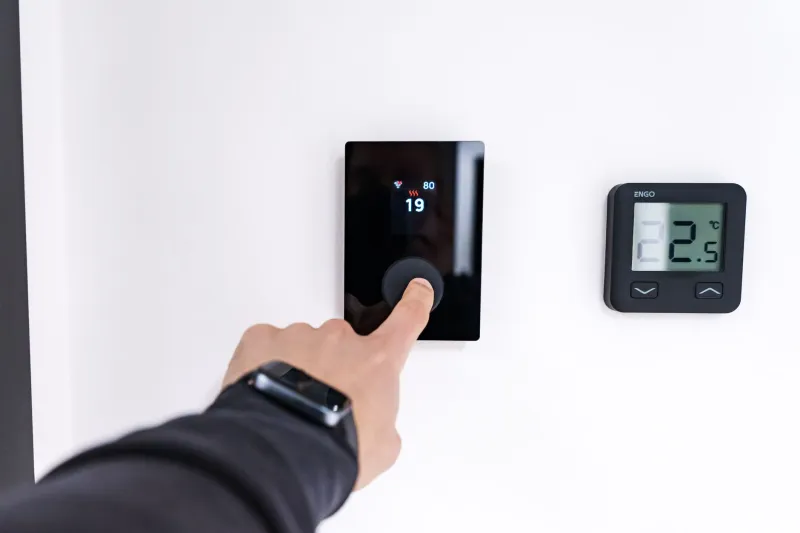
Programmable thermostats have transformed the usability of radiant systems significantly. Early installations required manual adjustment; contemporary smart thermostats allow homeowners to schedule warm-up cycles around their routines, so the floor reaches a comfortable temperature before the alarm sounds rather than fifteen minutes after stepping out of the shower.
Heated Towel Rails: Function Elevated to Ritual
The heated towel rail occupies a unique position in this conversation. It is simultaneously a functional fixture—a place to hang and dry towels—and a sensory experience that many users describe as unexpectedly transformative. Stepping from a shower and wrapping oneself in a towel that has been gently warmed for the previous twenty minutes is, by any reasonable measure, a small luxury with an outsized effect on how a bathroom feels to use.
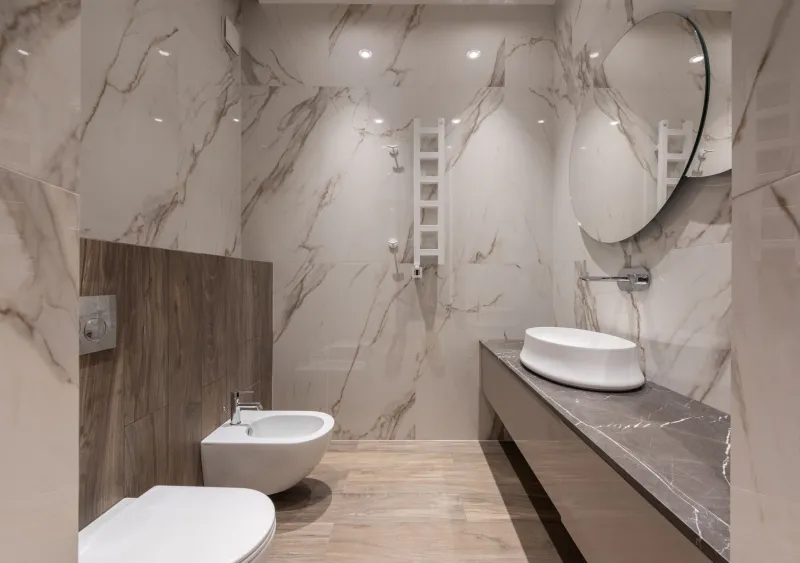
In the American market, heated towel rails have historically been viewed as a European import, more common in British and Scandinavian bathrooms than in domestic ones. That perception is changing. Luxury builders in markets like Aspen, the Hamptons, and coastal California now routinely include them as standard, and the product category itself has expanded considerably—from utilitarian ladder-style rails to sculptural wall-mounted designs that function as genuine focal points.
Hardwired electric models offer the most reliable performance and the cleanest installation, while plug-in versions provide flexibility for homeowners who want to introduce the feature without committing to an electrical rough-in. Both categories are now available in a wide range of finishes—polished chrome, brushed nickel, matte black, and even aged brass—making coordination with existing hardware straightforward.
Smart Thermostats and Whole-Room Climate Management
The most sophisticated expression of bathroom temperature control moves beyond individual heated surfaces to treat the entire room as a managed climate zone. This approach integrates radiant floor heating, towel rail controls, ventilation fans, and sometimes even mirror defoggers into a single smart home interface—typically accessible via a wall-mounted touchscreen, a smartphone application, or a voice assistant.
Systems from manufacturers such as Nuheat, Warmup, and Schluter-DITRA-HEAT now offer app-based scheduling, geofencing capabilities that begin warming the bathroom as you approach home, and energy monitoring that allows homeowners to track consumption and adjust usage accordingly. For those invested in whole-home automation platforms like Control4 or Lutron, bathroom climate management integrates naturally into the broader system.
Ventilation is a frequently overlooked component of this picture. High-humidity environments accelerate the deterioration of materials, contribute to mold growth, and create the kind of oppressive post-shower atmosphere that undermines even the most carefully designed space. Smart ventilation fans—units from Panasonic's WhisperSense line or Broan's range of humidity-sensing models—detect moisture levels automatically and adjust their output accordingly, maintaining air quality without requiring manual operation.
The Wellness Dimension
Beyond comfort, there is a growing body of evidence connecting thermal environments to measurable wellness outcomes. Chronic cold exposure—particularly in the early morning hours when core body temperature is naturally lower—has been associated with elevated cortisol levels and disrupted circadian rhythms. A bathroom that maintains a consistent, comfortable temperature from the first step inside may contribute, in modest but real ways, to a calmer morning routine.
Conversely, the deliberate contrast of a warm room followed by a cool-water rinse has roots in hydrotherapy traditions practiced across European and Japanese wellness cultures. Some luxury homeowners are designing their bathrooms to support both experiences—a heated floor and towel rail for the morning routine, a programmable shower system capable of cold-water sequences for post-workout recovery.
Installation Considerations and Investment
For homeowners considering a temperature-focused renovation, sequencing is important. Radiant floor heating must be installed before the finished floor surface is laid, making it most economical to incorporate during a tile replacement or full bathroom renovation. Adding it as a standalone project to an existing bathroom is possible but involves more disruption and cost.
Budget ranges vary considerably by system type and bathroom size. Electric radiant mat systems for a standard primary bathroom (roughly 80 to 120 square feet) typically run between $500 and $1,500 for materials, with installation adding $300 to $800 depending on the complexity of the existing floor assembly. Smart thermostat upgrades for existing systems are among the more accessible entry points, often costing $150 to $400 installed.
From a resale perspective, temperature-related upgrades are among the more transferable luxury features—they are immediately legible to prospective buyers, require no explanation, and are experienced directly during a showing. A bathroom that feels comfortable and well-considered on a cold January morning in Chicago or Denver communicates quality in a way that no amount of staging photography can replicate.
The temperature revolution in luxury bathroom design is, at its core, a shift in what buyers and homeowners consider non-negotiable. Aesthetics remain important—they always will. But the bathrooms that leave the deepest impression are increasingly the ones that are simply, unmistakably pleasant to be inside.