Designed for Decades: The New Aesthetic of the Accessible Luxury Bathroom
There is a particular kind of design intelligence that reveals itself only over time. A kitchen that functions as well at seventy as it does at forty. A bedroom that accommodates the full arc of a life without ever feeling clinical. And increasingly, a bathroom that anticipates the body's changing relationship with space, balance, and ease—without announcing that anticipation in any visible way.
This is the new frontier of luxury bathroom design in the United States: the aging-in-place bathroom that reads, unambiguously, as a luxury bathroom. Not a medical space. Not a concession. A room of genuine beauty and considered function that simply happens to have been designed with the next thirty years in mind.
The market for this approach is substantial and accelerating. The oldest Baby Boomers are now in their late seventies. Millennials—the generation currently driving the premium renovation market—are watching their parents navigate homes that were never designed for later life, and they are making different decisions for themselves. According to the National Association of Home Builders, the demand for universal design features in residential construction has grown steadily for over a decade, with bathrooms consistently ranking as the highest-priority space for accessibility upgrades.
What has changed is not the demand. It is the design vocabulary available to meet it.
The Grab Bar Reinvented
For most of the twentieth century, the grab bar was the defining symbol of the accessible bathroom—and a reliable aesthetic liability. Chrome-plated steel tubes bolted to tile walls at prescriptive angles communicated one thing clearly: someone in this household requires assistance. The visual language was institutional, the installation was obtrusive, and the effect on a carefully designed space was immediate and difficult to mitigate.
Contemporary grab bar design has addressed this problem with remarkable thoroughness. Manufacturers including Kohler, Moen, and a number of European-origin brands now produce grab bars in finishes—brushed gold, matte black, polished nickel, unlacquered brass—that are indistinguishable from the decorative accessories surrounding them. More significantly, integrated designs now embed grab bar functionality into towel bars, robe hooks, and shower niches, eliminating the visual category entirely.
The structural requirements have not changed: a properly installed grab bar must be anchored to blocking or studs capable of supporting a 250-pound dynamic load. What has changed is that this engineering can now be accomplished behind a surface that presents, to any observer, as a beautifully proportioned towel bar in a coordinating finish. The accessibility is real. The evidence of it is invisible.
For homeowners planning a new build or a full renovation, the most prudent approach is to install blocking throughout the shower and around the toilet during the rough-in phase, even if no grab bars are specified at the time of completion. Retrofitting blocking into a tiled wall is a disruptive and expensive undertaking. Installing it during construction costs almost nothing and preserves every future option.
The Walk-In Shower as Universal Standard
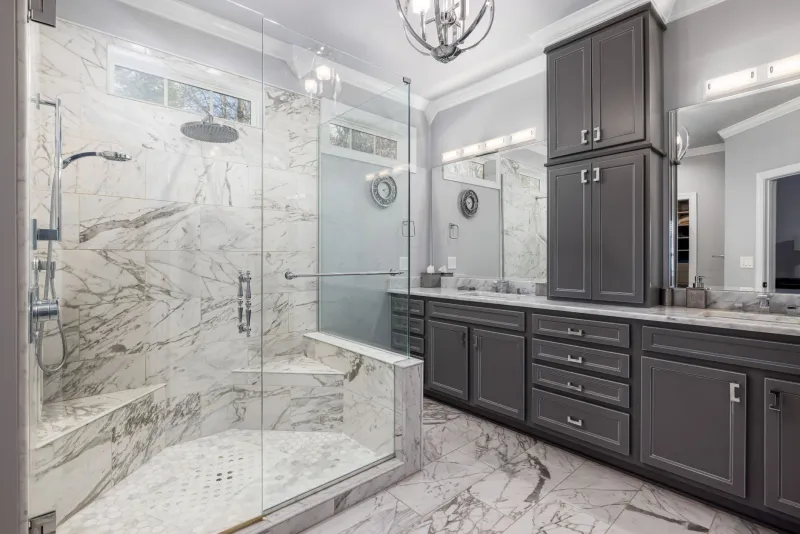
Perhaps no single design decision does more to future-proof a bathroom—while simultaneously elevating its aesthetic—than the elimination of the shower threshold. The curbless, or zero-threshold, shower has been standard in European luxury bathroom design for decades. Its adoption in the American market has accelerated meaningfully in the past ten years, driven partly by accessibility awareness and partly by the simple recognition that a continuous floor plane is more beautiful than one interrupted by a curb.
A properly executed curbless shower requires a precisely engineered linear or point drain positioned to manage water containment without relying on a physical barrier. The slope of the shower floor—typically a quarter-inch drop per foot toward the drain—must be executed with care to avoid the pooling that plagues poorly installed curbless designs. When done correctly, the result is a shower that a person using a walker, a wheelchair, or simply carrying an infant can enter without negotiation—and that reads, in photographs and in person, as a masterwork of minimalist design.
For homeowners over fifty, or those designing for a parent or for their own long-term use, the curbless shower is perhaps the single most high-value accessibility investment available. It is also, by most measures, a positive resale feature in the premium market.
Heated Floors: Where Safety and Comfort Converge
Radiant floor heating has long been a fixture of the luxury bathroom conversation, valued primarily for the sensory pleasure of stepping onto a warm stone or tile surface on a cold morning. Its safety dimension is less frequently discussed but equally significant.
Cold floors are a meaningful fall risk in bathrooms, particularly when wet. The physiological reflex to withdraw quickly from an uncomfortably cold surface can disrupt balance in ways that a warm floor simply does not. Radiant heat also accelerates the drying of floor surfaces after showering, reducing the window of time during which a wet floor poses a slip hazard.
For homeowners investing in premium materials—large-format marble, honed limestone, textured porcelain—the addition of an electric or hydronic radiant system beneath the tile is a modest incremental cost relative to the overall project budget. The comfort benefit is immediate. The safety benefit compounds over time.
Fixtures That Speak the Language of Luxury
The lever-handle faucet is, by the standards of universal design, a straightforward accessibility feature: it requires no grip strength and can be operated with a closed fist, an elbow, or a wrist. It is also, in the contemporary luxury market, simply the more prevalent and more aesthetically sophisticated choice.
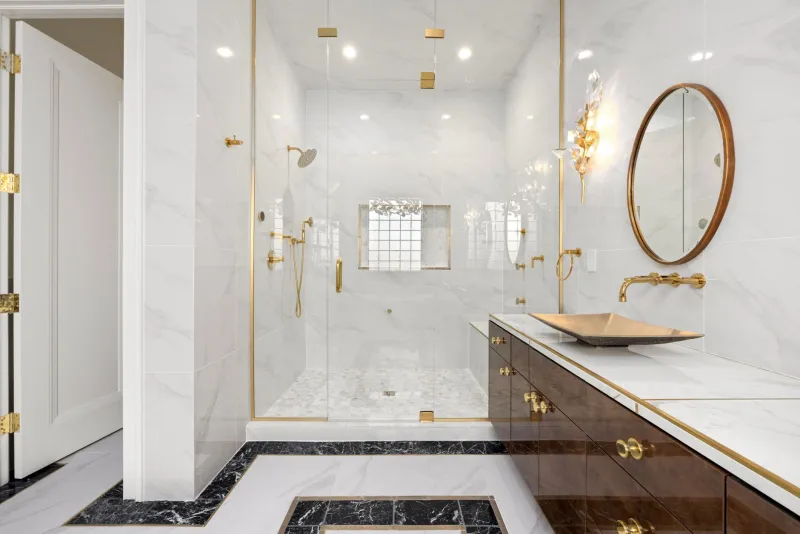
Wall-mounted faucets with extended lever handles in architectural finishes—the kind specified in boutique hotels and high-end residential projects alike—satisfy accessibility criteria while reading as design decisions rather than accommodations. The same logic applies to pressure-balance shower valves with large-format lever or paddle controls, to comfort-height toilets (which meet ADA height specifications while appearing standard to most observers), and to undermount sinks set at counter heights that accommodate seated use without appearing lowered.
The design principle at work here is one of integration rather than addition. Accessibility features that are designed into the fixture selection from the outset are invisible as accessibility features. They are simply good design.
Planning for the Long View
The homeowner who approaches a bathroom renovation as a thirty-year investment thinks differently than one optimizing for immediate resale or aesthetic novelty. The questions shift. Not simply: does this look beautiful today? But also: will this function well when my balance is less reliable? When I am recovering from a surgery? When a parent comes to stay for an extended period?
These are not grim questions. They are, in fact, the questions that produce the most thoughtful and enduring design. A bathroom designed with genuine longevity in mind—one that anticipates the full range of human experience rather than only its most able-bodied expression—tends to be a bathroom that is simply better: more spacious, more considered, more quietly confident in its choices.
At Seven Bathrooms, we have observed this shift in our clients' priorities over the past several years with something approaching admiration. The decision to design a bathroom for decades rather than seasons is, ultimately, an act of optimism—a statement that the life being lived in this space is worth planning for, carefully and beautifully, for a very long time to come.