The Beautiful Threat Within: How Moisture Mismanagement Is Quietly Undermining Even the Finest Luxury Bathrooms
There is a particular irony embedded in the world of luxury bathroom design. The features that define a high-end installation—extended steam showers, soaking tubs, radiant heat, multi-head spray systems—are precisely the features that generate the most moisture. And yet, in many renovations that prioritize surface beauty above all else, the infrastructure required to manage that moisture is treated as an afterthought.
The consequences rarely announce themselves immediately. Moisture damage is patient. It works behind walls, beneath subfloors, and inside ceiling cavities for months or years before it becomes visible. By the time a homeowner notices warping cabinetry, a persistent musty odor, or grout that inexplicably refuses to hold, the underlying damage may already be extensive—and expensive.
This is the humidity paradox at the heart of luxury bathroom design: the more sophisticated the bathroom, the greater the moisture load it generates, and the more rigorous the moisture management strategy must be. Homes that invest heavily in surface-level elegance but neglect this foundational requirement are not building luxury bathrooms. They are building beautiful problems.
Why Luxury Bathrooms Generate Disproportionate Moisture Loads
A standard residential bathroom produces a meaningful amount of humidity during daily use, but the exposure is typically brief and the volume of water involved is relatively modest. A luxury bathroom operates on an entirely different scale.
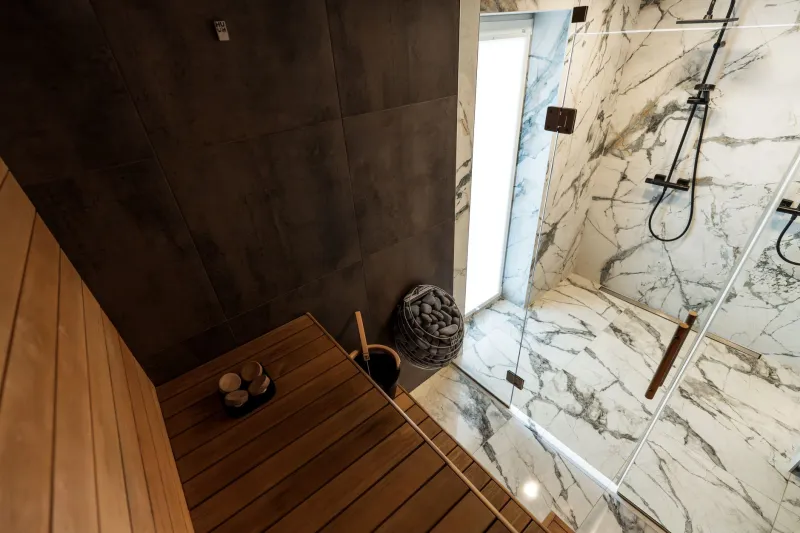
Consider a steam shower enclosure—a fixture now common in upper-tier renovations across the United States. A residential steam unit operating at full capacity can introduce several pounds of water vapor into an enclosed space within minutes. When that enclosure is not properly sealed, or when the adjacent wall assemblies lack adequate vapor barriers, that moisture migrates. It moves through grout lines, around improperly flashed fixtures, and through the microscopic gaps that exist in virtually every construction assembly.
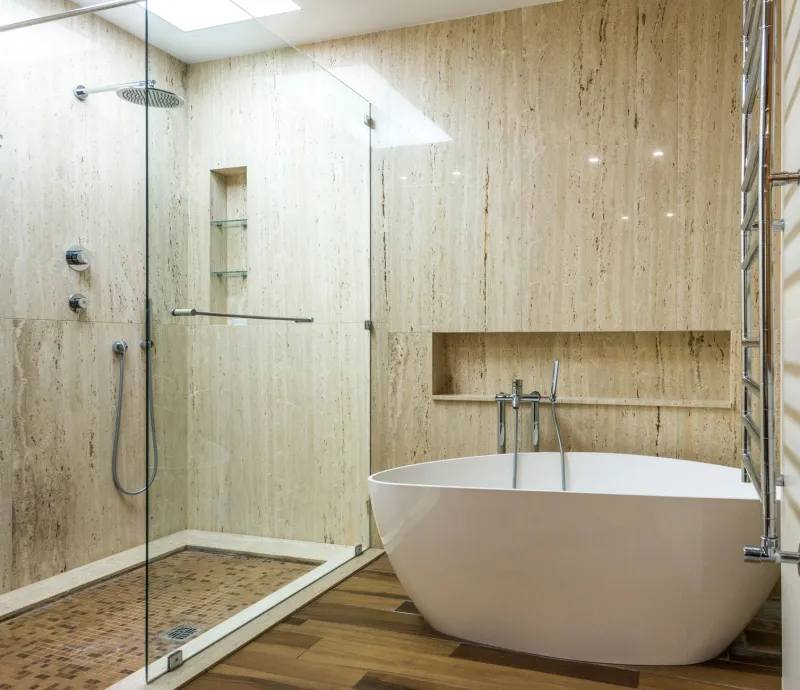
Large soaking tubs present their own challenges. Freestanding installations, in particular, are frequently positioned away from walls, which means that splashing, evaporation, and overflow events occur in zones that were not always designed to handle sustained moisture exposure. Similarly, heated towel rails and radiant floor systems alter the thermal dynamics of a bathroom in ways that affect condensation patterns—sometimes directing moisture toward wall cavities rather than away from them.
The result is a bathroom environment that can sustain elevated relative humidity for hours after use, creating conditions that are highly favorable to mold growth, wood deterioration, and the slow degradation of adhesive bonds beneath tile and stone.
The Vapor Barrier Problem No One Wants to Talk About
Vapor barriers are unglamorous. They do not appear in design renderings, they are not mentioned in showroom consultations, and they add cost without adding anything a homeowner can see or touch. This makes them chronically underspecified in luxury renovations, where the conversation tends to gravitate toward finishes, fixtures, and spatial planning.
The science, however, is unambiguous. In a wet area, the vapor retarder must be correctly positioned relative to the wall assembly's thermal profile—a calculation that varies depending on climate zone, interior conditions, and the specific materials used in construction. In much of the northern United States, where winters are cold and indoor heating keeps interior surfaces warm, vapor barriers are typically placed on the warm side of the insulation. In humid southern climates, the calculus can reverse entirely.
Installing a vapor barrier in the wrong location does not simply fail to help—it can actively concentrate moisture within the wall assembly, accelerating exactly the kind of damage it was meant to prevent. This is a mistake that occurs with troubling frequency in luxury renovations, where contractors experienced in finish work may not have deep expertise in building science.
The most resilient installations treat the entire bathroom as a moisture management system, not a collection of isolated components. This means continuous waterproofing membranes beneath tile, properly detailed transitions at curbs and thresholds, appropriate drain placement relative to floor slope, and ventilation that is sized not for a code minimum but for the actual moisture load the bathroom will produce.
When Adjacent Spaces Pay the Price
One of the more disorienting aspects of bathroom moisture damage is how far it can travel before becoming apparent. A master bathroom on the second floor of a home shares structural elements with the bedroom beside it, the hallway beyond, and the ceiling of the room below. Moisture that infiltrates a wall cavity does not respect room boundaries.
In documented cases across the country, homeowners have discovered that persistent bathroom humidity was responsible for warped hardwood floors in adjoining bedrooms, paint failure on exterior walls, and mold colonies inside closets that shared a common wall with the shower. In one particularly costly scenario—representative of a pattern seen repeatedly in high-end residential construction—a steam shower that had been installed without a continuous ceiling membrane allowed vapor to accumulate in the structural framing above, leading to rot that required partial roof deck replacement.
The financial exposure in these situations is substantial. Remediation costs for mold and structural moisture damage routinely run into the tens of thousands of dollars, and in severe cases, they can dwarf the original renovation budget. Homeowner's insurance policies frequently contain exclusions for damage attributed to long-term moisture infiltration, classifying it as a maintenance failure rather than a sudden loss.
Where Luxury Installations Fail Where Basic Ones Succeed
It is worth examining why a modest bathroom renovation sometimes outperforms a luxury one in terms of long-term moisture performance. The answer is often complexity.
A straightforward bathroom with a single shower, standard ventilation, and conventional tile work presents fewer moisture management challenges than a spa-inspired suite with multiple water sources, radiant heat, steam, and elaborate stonework. Each additional feature introduces new moisture pathways, new sealing requirements, and new opportunities for the system to fail at an interface.
Luxury renovations also tend to involve more trades, more scheduling pressure, and more opportunities for critical waterproofing steps to be rushed or skipped between the work of different contractors. A tile installer who arrives to find that the waterproofing membrane has not been fully cured may proceed anyway, under schedule pressure, creating a bond that will fail under sustained moisture exposure.
Professional commissioning—a process in which the completed installation is systematically tested before it is closed up behind finishes—is one of the most effective tools available for catching these failures before they become permanent. Yet it remains the exception rather than the rule in residential luxury construction.
Building Moisture Strategy Into the Design from the Start
The most durable luxury bathrooms share a common characteristic: moisture management is not addressed as a separate checklist item after the design is complete. It is woven into the design itself from the earliest planning stages.
This means selecting ventilation equipment that is matched to the actual cubic footage and moisture output of the space, not simply to code requirements. It means specifying waterproofing systems by name and requiring written confirmation that installation has been completed to manufacturer standards. It means detailing every penetration—every fixture, every drain, every niche—as a potential moisture pathway that requires deliberate sealing.
It also means having an honest conversation about materials. Certain natural stones are highly porous and require ongoing sealing to resist moisture absorption. Some wood species used in vanity construction are more dimensionally stable than others under humidity cycling. These are not merely aesthetic choices—they are moisture management decisions with long-term consequences.
A bathroom that performs beautifully for a decade or more is not the product of expensive fixtures alone. It is the product of a design team and construction crew that understood, from the first conversation to the final inspection, that controlling moisture was not a secondary concern. It was the foundation upon which everything else was built.
At Seven Bathrooms, we believe that genuine luxury is measured not only by what a space looks like on the day it is completed, but by how it performs across years of daily use. Moisture management is not the most visually compelling subject in bathroom design. It is, however, among the most consequential—and the homeowners who understand that distinction are the ones who never have to explain to their contractor why the wall behind the shower is failing three years after a six-figure renovation.