Mirrors That Lie: How Luxury Bathrooms Are Getting Reflection Design Dangerously Wrong
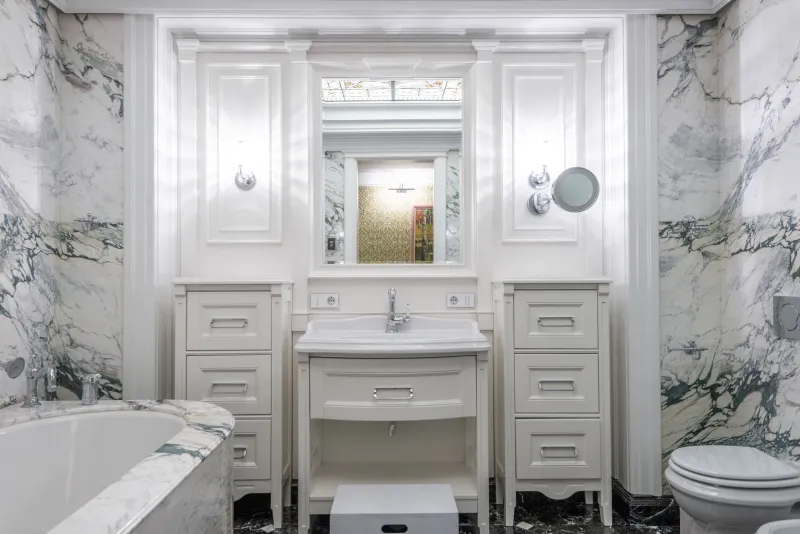
There is a particular kind of disappointment that arrives not with the bill, but with the morning light. A homeowner steps into their newly renovated bathroom—marble floors, custom cabinetry, a rainfall shower imported from a European manufacturer—and catches their reflection in the statement mirror they spent weeks selecting. Something is wrong. The shadows are harsh. The proportions feel distorted. The face looking back does not match the one they recognize from their phone camera or the powder room at their favorite restaurant.
This experience is more common than the luxury renovation industry cares to admit. And it is not a problem of vanity. It is a problem of design.
The Mirror Is Not the Problem—The System Around It Is
When clients invest in a high-end bathroom renovation, significant attention is paid to the mirror itself: its frame, its finish, the relationship of its dimensions to the vanity below it. What receives far less scrutiny is the optical ecosystem in which that mirror operates. Mirror placement, the geometry of light sources relative to the viewer's face, the distance between the glass and the point of use—these variables collectively determine whether a reflection flatters or distorts. And in many luxury bathrooms, they are addressed as afterthoughts.
The fundamental issue is that most residential bathroom mirrors are mounted too high, too close, and illuminated from the wrong direction. A mirror positioned such that its center sits above eye level forces the viewer to tilt their chin upward, stretching the neck and compressing facial features in a way that reads as unflattering. A mirror mounted directly above a vanity, flush to a backsplash, often places the viewer too close to the glass—anywhere under eighteen inches collapses depth perception and exaggerates every pore and asymmetry. These are not minor aesthetic quibbles. They are optical physics.
How Lighting Geometry Shapes What You See
The relationship between light and reflection is where most luxury bathroom designs fall furthest short. Recessed ceiling fixtures positioned directly overhead cast shadows downward across the face—into the hollows beneath the eyes, along the sides of the nose, under the jawline. This is the least flattering light geometry known to portrait photography, and it is the default condition of thousands of beautifully finished American bathrooms.
The alternative, which hospitality designers and film lighting directors have understood for decades, is to flank the mirror with vertical light sources positioned at or near face height. Sconces or integrated LED strips mounted on either side of the mirror—at approximately sixty to sixty-five inches from the finished floor to their center—wrap light around the face from multiple horizontal angles simultaneously. This eliminates directional shadow, renders skin tones more accurately, and produces the kind of even, diffuse illumination that allows a person to make accurate grooming decisions.
Color temperature matters equally. Fixtures in the 2700K to 3000K range emit a warm tone that is comfortable and residential but meaningfully distorts color accuracy. A person applying makeup or evaluating their complexion under 2700K light and then stepping into the 5000K daylight outside will find the two readings bear little resemblance to each other. Forward-thinking designers are now specifying tunable white fixtures—capable of shifting across the spectrum from warm to daylight—so that the bathroom mirror can serve as a reliable reference point regardless of the hour or the task.
The Viewing Distance Problem Nobody Talks About
Architectural trends in luxury bathroom design have consistently favored larger mirrors—full-width vanity mirrors, floor-to-ceiling reflective panels, integrated mirror walls that amplify the sense of space. These are visually compelling choices. They can also be functionally counterproductive.
A mirror that spans the full width of a double vanity, mounted directly against the wall above the backsplash, may place the user's face as close as twelve to fifteen inches from the glass when they lean in to examine their skin or apply product. At that distance, the reflection is optically unreliable. The eye cannot properly process depth, and the brain interprets the resulting image with a degree of distortion that simply does not exist at the distances from which other people actually view us—typically three to six feet.
The solution is not necessarily a smaller mirror. It is a more deliberate relationship between the vanity depth, the mirror's mounting position, and the user's natural standing posture. Some designers are now specifying mirrors mounted slightly forward of the wall plane on angled brackets, or incorporating a shallow recessed niche behind the vanity that increases the effective distance between the user and the glass without requiring additional floor space. Others are treating a secondary, freestanding mirror—positioned at an optimal distance and angle—as a non-negotiable element of the grooming zone, distinct from the decorative mirror above the sink.
Angle, Tilt, and the Honest Reflection
Perhaps the most underutilized tool in mirror design is tilt. A mirror mounted at a slight downward angle—two to five degrees from vertical—shifts the reflected image to approximate the viewing angle at which a person appears to others at eye level. It is a subtle intervention with a meaningful perceptual effect. The technique has long been employed in high-end retail fitting rooms, where the commercial incentive to produce a flattering reflection is explicit. There is no reason it should not be applied with equal intentionality in the residential bathroom.
Full-length mirrors present their own set of considerations. A floor-length mirror positioned flat against a wall will reflect the viewer from directly in front—an angle that, depending on posture and the mirror's height relative to the viewer's body, may compress or elongate the silhouette in ways that feel inaccurate. A slight outward tilt at the top—again, two to three degrees—corrects for this by shifting the reflection toward the angle at which the viewer would appear to someone standing across a room.
Designing for Honest Reflection
The aspiration of a truly well-designed luxury bathroom is not simply to look beautiful in photographs. It is to serve the person who inhabits it with intelligence and care. A bathroom that presents its occupant with an honest, flattering, and contextually accurate reflection each morning is performing one of its most fundamental functions. A bathroom that does not—regardless of the quality of its stone, its hardware, or its fixtures—has failed at something essential.
The good news is that the corrections required are rarely structural. Adjusting a mirror's height, adding flanking sconces, specifying a tunable light source, introducing a secondary mirror at an optimal distance—these are design decisions, not demolition projects. They require intention rather than budget.
At Seven Bathrooms, we believe that the spaces we help design and furnish should make the people who use them feel better, not worse. That standard applies to every surface, every fixture, and every angle of light. The mirror is where the bathroom makes its most personal argument. It deserves to be right.