Illuminating the Luxury Bathroom: A Complete Guide to Layered Lighting Design
There is a particular frustration that surfaces in high-end bathroom renovations—one that rarely gets discussed openly. A homeowner invests in hand-selected marble, a freestanding soaking tub sourced from a European atelier, and custom cabinetry finished with brushed unlacquered brass hardware. Then the project is complete, the contractor departs, and something feels inexplicably off. The finishes appear dull. The room feels smaller than it should. The mirror is practically unusable for morning grooming. In the vast majority of these cases, the culprit is not the tile, the fixtures, or the layout. It is the lighting.
Lighting is the single most underestimated element in luxury bathroom design, and it is also among the most consequential. Understanding why so many renovations get it wrong—and precisely how to correct course—begins with a concept that professional designers refer to as layered illumination.
The Three-Layer System: Why a Single Source Is Never Enough
The most common lighting error in residential bathrooms is relying on one overhead fixture to accomplish everything. A recessed can light centered in the ceiling, or even a decorative pendant, cannot simultaneously provide flattering task illumination, establish ambient warmth, and highlight architectural or material details. Each of those functions requires its own dedicated layer.
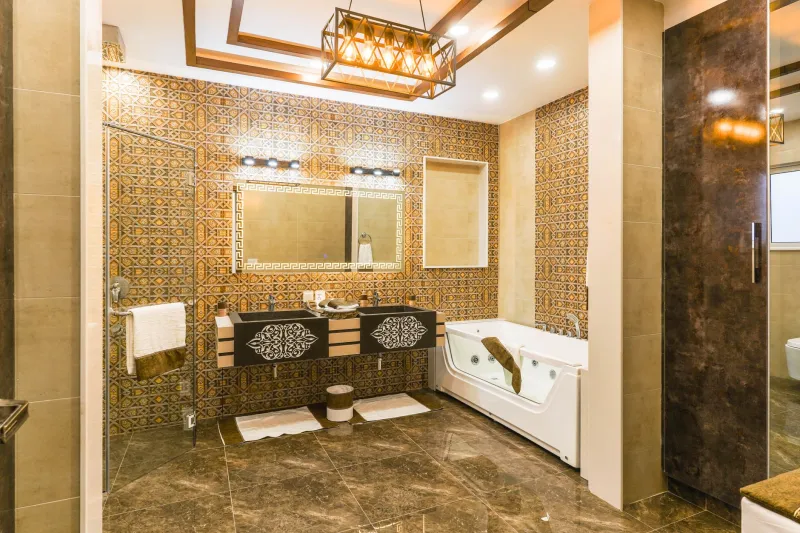
Ambient lighting forms the foundational layer—the general illumination that fills the room and sets its overall tone. In a luxury bathroom, this layer is best achieved through a combination of recessed fixtures and indirect sources such as cove lighting or LED strip systems concealed behind valances or within ceiling coffers. The goal is even, shadow-free coverage that does not feel clinical or institutional.
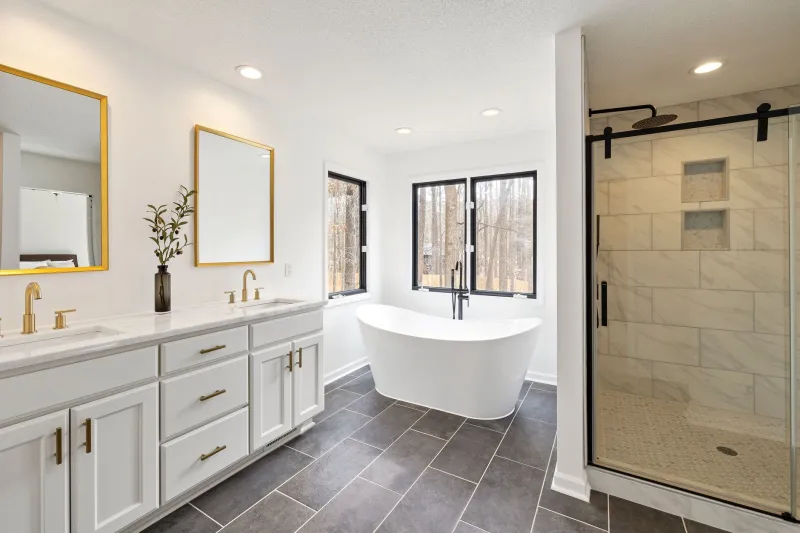
Task lighting serves the mirror and vanity zones specifically. This is where most renovations fail most visibly. Overhead recessed lighting positioned directly above a person standing at the mirror casts harsh downward shadows across the face—precisely the effect that flatters no one. The professional solution is side-mounted sconces placed at eye level, flanking the mirror at a height of approximately 60 to 65 inches from the finished floor. For wider vanity configurations or illuminated mirror cabinets, linear LED strips integrated into the mirror frame itself provide consistent, shadow-eliminating light from multiple angles simultaneously.
Accent lighting constitutes the third layer and is perhaps the most powerful tool for communicating luxury. This layer draws deliberate attention to the elements that deserve it: a textured stone feature wall, a sculptural freestanding tub, or an architectural niche displaying curated objects. Low-voltage directional fixtures, in-floor uplights, and toe-kick LED systems all serve this function. Used with restraint, accent lighting transforms a beautiful bathroom into an experiential one.
Color Temperature: The Detail That Changes Everything
Beyond fixture placement, color temperature is the variable that most profoundly affects how a bathroom looks and feels. Measured in Kelvin (K), color temperature determines whether a light source reads as warm, neutral, or cool.
For luxury residential bathrooms, the range of 2700K to 3000K is generally considered optimal. At 2700K, light carries a warm, incandescent quality that flatters skin tones and lends an intimate, spa-like atmosphere to the space. At 3000K, the tone is slightly crisper while remaining comfortably warm—a versatile choice for bathrooms that serve both relaxation and functional grooming needs.
Temperatures above 3500K begin to read as cool or neutral white, which can make even premium materials appear flat and institutional. Crisp white Calacatta marble may look magnificent under warm light; under a 4000K cool-white source, it risks appearing gray and lifeless.
For homeowners who want flexibility across different times of day and different uses, tunable white LED systems now allow color temperature to shift between warm evening settings and slightly cooler morning modes—all controlled through a single dimmer or smart home application.
Mirror Configuration and Its Lighting Implications
The style of mirror selected for a vanity has direct implications for how task lighting must be approached, and this relationship is frequently overlooked during the planning phase.
A frameless plate mirror spanning the full width of the vanity pairs most effectively with integrated vertical sconces mounted to the wall on either side, or with a recessed channel of LED lighting built directly into the ceiling immediately above the mirror's top edge. This approach avoids the awkward visual break that occurs when sconces interrupt a seamless mirror surface.
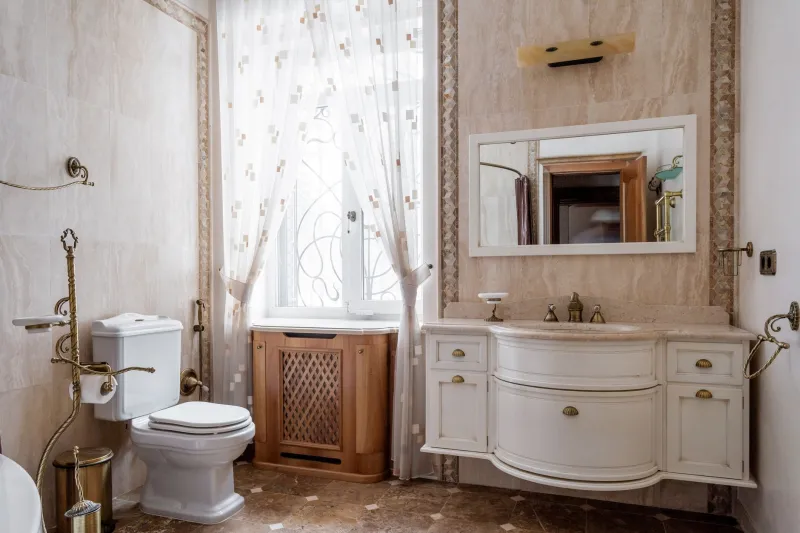
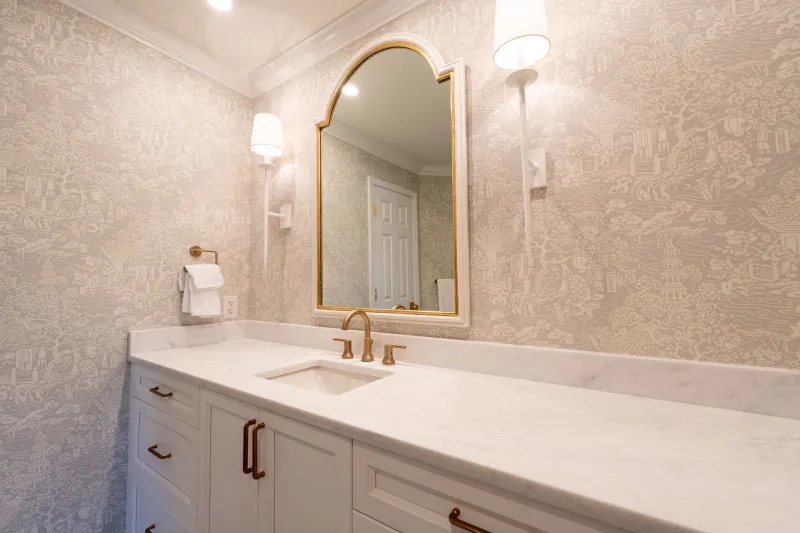
A framed statement mirror—particularly the round, arched, or irregular forms currently prominent in transitional and contemporary luxury design—typically works best with sconces positioned to the sides rather than above, preserving the mirror's sculptural presence as a focal point.
Illuminated mirror cabinets, increasingly popular in master bathrooms where storage and aesthetics must coexist, incorporate their own light source and therefore require coordination rather than duplication. Supplementing an illuminated mirror cabinet with additional task lighting risks overexposure and a harsh, overly bright vanity zone.
Dimming, Controls, and the Architecture of Atmosphere
No lighting design is complete without a control strategy. In a luxury bathroom, every circuit should be dimmable—without exception. The ability to reduce ambient lighting to 20 or 30 percent while a freestanding tub fills is not merely a comfort; it is the defining characteristic of a space that functions as a genuine retreat.
Multi-scene dimmer systems allow homeowners to program distinct lighting scenarios—a bright morning setting optimized for grooming, a relaxed evening setting for bathing, and a low-level overnight setting for navigating the space without full illumination. These systems, now available from manufacturers including Lutron and Leviton at a range of price points, integrate seamlessly with broader smart home platforms.
The Return on Attention
Lighting a luxury bathroom correctly requires no more square footage, no structural modification, and in most cases only a modest incremental investment relative to the overall project budget. What it demands is attention—at the design phase, before walls are closed and tile is set. The homeowner who insists on a lighting plan as rigorous as the material selection plan will find that every other investment in the space performs better for it. The marble looks richer. The fixtures read as more refined. The room, in every sense of the word, comes to life.