The Silent Luxury: How Acoustic Engineering Is Redefining the High-End Bathroom
Walk into the bathroom of a genuinely world-class hotel—a Rosewood, a Four Seasons, a Aman—and something registers before you consciously identify it. The space feels different. Calmer. More contained. The ventilation fan does not announce itself. The shower does not reverberate against hard walls like a percussion section. The door closes with a soft, pressurized thud rather than a hollow clap. What you are experiencing is not accidental. It is the result of deliberate acoustic engineering, and it is the single most overlooked dimension of luxury bathroom design in the American residential market.
For homeowners investing tens or even hundreds of thousands of dollars in their bathrooms, the acoustic environment deserves the same rigorous attention as the tile selection or the plumbing fixtures. Sound, after all, is not merely background. It is a physiological experience—one that can either deepen a sense of retreat or quietly undermine it.
Why Bathrooms Are Acoustically Hostile by Default
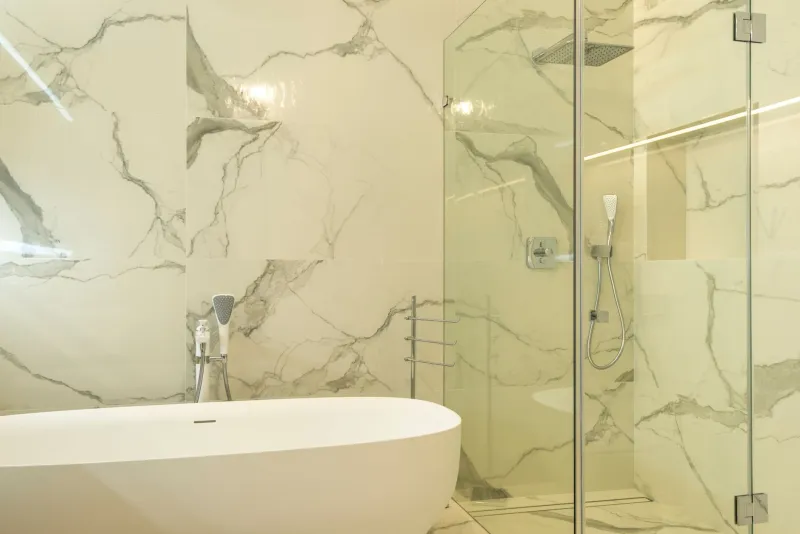
The standard American bathroom is, from an acoustic standpoint, a near-worst-case scenario. Hard surfaces dominate: porcelain tile, glass enclosures, stone countertops, acrylic or cast-iron tubs. These materials are chosen for their durability, their hygiene, and their visual appeal—all entirely valid criteria. But they share one unfortunate property: they reflect sound rather than absorbing it.
The result is a space with a long reverberation time—the measure of how long a sound persists after its source stops. In a reverberant room, voices become muddied, mechanical noise from fans and pipes seems amplified, and the shower's water impact against the floor and walls creates a diffuse, enveloping roar rather than a clean, focused sound. The room may be gorgeous. It does not feel serene.
High-end hospitality projects address this through a combination of material science, mechanical engineering, and architectural detailing. Residential designers can apply the same toolkit, often with less disruption than homeowners expect.
Sound-Dampening Materials That Do Not Sacrifice Aesthetics
The most effective acoustic intervention in a bathroom is also one of the least visible: the decoupling layer beneath the tile. Standard tile installations bond directly to a cement backer board, which transmits impact noise—footsteps, dropped objects, the thud of water against a shower floor—directly into the subfloor and down through the structure of the house. Acoustic underlayment membranes, such as those made from recycled rubber or cork composites, interrupt this transmission path. They add minimal height to the floor assembly and are completely invisible once the tile is laid. The difference in impact noise reduction can be measured in the range of 15 to 22 decibels—a perceptible and meaningful change.
For walls, the calculus is slightly different. Tile on walls primarily reflects airborne sound rather than transmitting impact noise, so the intervention shifts to the wall assembly itself. Resilient channel mounting—a technique borrowed from recording studio construction—decouples the drywall layer from the studs, preventing sound from traveling through the framing. In a bathroom adjacent to a bedroom, this detail alone can transform the acoustic relationship between the two spaces.
Grout joint width and profile also play a small but non-trivial role. Wider grout joints with slightly recessed profiles introduce micro-level surface irregularity that scatters sound rather than reflecting it uniformly. This is a detail that your tile installer can execute without any specialized knowledge; it simply requires specifying it in advance.
The Ventilation Problem—and Its Elegant Solution
Nothing betrays a bathroom's acoustic credentials faster than its exhaust fan. The standard builder-grade unit—a rattling, droning box mounted in the ceiling—is among the most acoustically offensive fixtures in the American home. It is also among the easiest to upgrade.
The luxury ventilation market has matured considerably. Units from manufacturers such as Panasonic's WhisperCeiling line, Broan's Sensonic series, and several European-origin brands now achieve noise ratings as low as 0.3 sones—a measurement so close to silence that the fan's presence is detected only by the faint movement of air. These units often incorporate humidity sensors that modulate fan speed automatically, maintaining the minimum airflow necessary rather than running at full capacity throughout a shower.
Installation matters as much as unit selection. Even a whisper-quiet fan will generate audible noise if its duct run is short, straight, and terminates abruptly at an exterior wall cap. Longer duct runs with gradual bends, insulated flex duct, and low-resistance exterior termination caps all contribute to a quieter system. Your HVAC contractor should treat the bathroom exhaust as a precision installation, not an afterthought.
Water Noise: Shaping the Sound of the Shower
The shower is the acoustic centerpiece of the bathroom—and the one element where sound design becomes genuinely nuanced. Some degree of water noise is not only acceptable but desirable; the sound of a well-pressured rainfall showerhead has a demonstrable masking effect on other ambient sounds, contributing to the sense of privacy and enclosure that defines a true retreat.
The goal is not silence but quality. A shower that sounds like a waterfall—layered, diffuse, and consistent—reads as luxurious. A shower that sounds like a pressure washer attacking a tile floor does not.
Rainfall-style showerheads with large face diameters distribute water across a wider impact zone, reducing the peak sound pressure of any single stream. Shower floors finished in matte or honed stone, rather than polished porcelain, absorb a small portion of impact energy rather than reflecting it entirely. Frameless glass enclosures with proper seals and heavy-gauge glass (10mm or thicker) contain shower sound more effectively than framed units with gaps at the door threshold.
For homeowners pursuing a genuinely high-performance acoustic environment, a niche product category worth investigating is the prefabricated shower module with integrated acoustic panels—units that incorporate sound-absorbing composite materials behind a finished surface. These are more common in European markets but are increasingly available through US specialty distributors.
The Heated Mirror: An Acoustic Detail in Disguise
It may seem counterintuitive to discuss heated mirror demister pads in an article about sound, but the connection is real. A fogged mirror is a bathroom problem that many homeowners solve by opening a window or running the exhaust fan at high speed—both of which introduce acoustic disruption. A demister pad, which maintains the mirror surface above the dew point and eliminates fogging entirely, removes the need for these compensatory measures. The bathroom can remain sealed, quiet, and thermally comfortable throughout use. It is a small detail with a disproportionate effect on the overall acoustic experience.
Designing for Acoustic Comfort: A Practical Checklist
For homeowners planning a renovation with acoustic quality as a priority, the following elements represent the highest-value interventions, roughly in order of impact:
- Acoustic underlayment beneath all tile — addresses impact noise at the source
- Resilient channel wall assembly — isolates the bathroom acoustically from adjacent spaces
- Ultra-low-sone exhaust fan with insulated ductwork — eliminates the most common source of mechanical noise
- Heavyweight frameless glass enclosure with tight seals — contains shower sound within the enclosure
- Rainfall showerhead with large face diameter — shapes water noise toward a more pleasant frequency profile
- Solid-core door with compression seals — the single most effective barrier between the bathroom and the rest of the home
None of these interventions requires exotic materials or specialized contractors. They require, primarily, intentionality—the decision to treat sound as a design criterion equal in importance to light, material, and form.
The most beautiful bathroom in the world loses something essential if it sounds like a locker room. Acoustic engineering is not the final luxury. It is, in many ways, the foundation on which all other luxury rests.