The Art of Controlled Contrast: Mastering Material Mixing in the Luxury Bathroom
There is a persistent myth in bathroom design: that cohesion requires uniformity. Walk through any high-end showroom and you may notice the assumption embedded in many displays — every fixture in the same finish, every surface in the same family of tones. It is a safe approach. It is also, increasingly, a dated one.
The most sophisticated luxury bathrooms being designed across the United States today share a different quality. They feel deliberate. They feel collected. They carry the kind of layered visual interest that takes a room from functional to genuinely memorable — not because every element matches, but because every element belongs.
Achieving that distinction is less about creative instinct and more about structural discipline. Specifically, it is about understanding how to work within a defined set of fixtures and surfaces — and how to make the relationships between those elements do the heavy lifting.
Why Constraint Is a Design Asset
Interior designers frequently reference the concept of intentional limitation as a counterintuitive path to visual richness. When a bathroom contains too many competing finishes — four metals, three stone varieties, and two wood tones — the eye has no place to rest. The space reads as busy rather than bold.
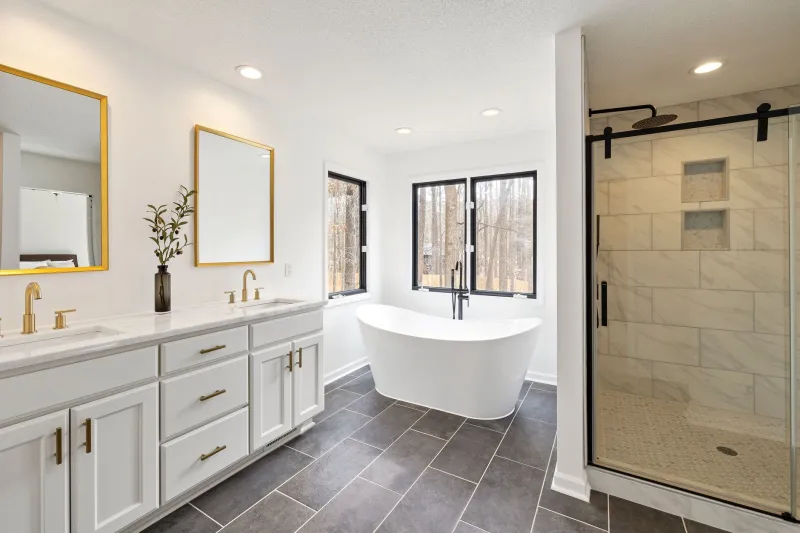
Conversely, when a designer commits to a small, carefully chosen palette of materials and applies them across a defined number of fixtures, the brain begins to perceive pattern. It reads the space as authored rather than assembled. The contrast between a matte black faucet and a brushed brass towel bar, for instance, creates tension — but if those same two finishes reappear consistently across the room's key touchpoints, that tension resolves into rhythm.
This is the core logic behind working with a fixed set of principal fixtures: the constraint forces intentionality, and intentionality produces coherence.
Establishing Your Material Hierarchy
Before selecting a single finish, it helps to think about your bathroom's fixtures in terms of visual weight and surface area. Not all fixtures command equal attention. A freestanding soaking tub anchors a room in a way that a robe hook simply does not. A statement vanity mirror carries more visual mass than a toilet paper holder.
A productive way to approach this is to rank your fixtures roughly from highest to lowest visual prominence:
- Primary fixtures (tub, vanity, shower enclosure, primary mirror)
- Secondary fixtures (faucets, showerhead, lighting pendants or sconces)
- Tertiary fixtures (towel bars, robe hooks, toilet paper holders, cabinet hardware)
Your dominant material — whether that is polished nickel, unlacquered brass, or matte black — should appear at the primary level. Your secondary material should appear at the secondary fixture tier. Tertiary fixtures can then either reinforce one of the established finishes or introduce a subtle accent that echoes a tone already present in the stone or tile.
This hierarchy prevents any single finish from overwhelming the room while ensuring that every material choice feels purposeful rather than accidental.
The Case for Warm-Cool Pairings
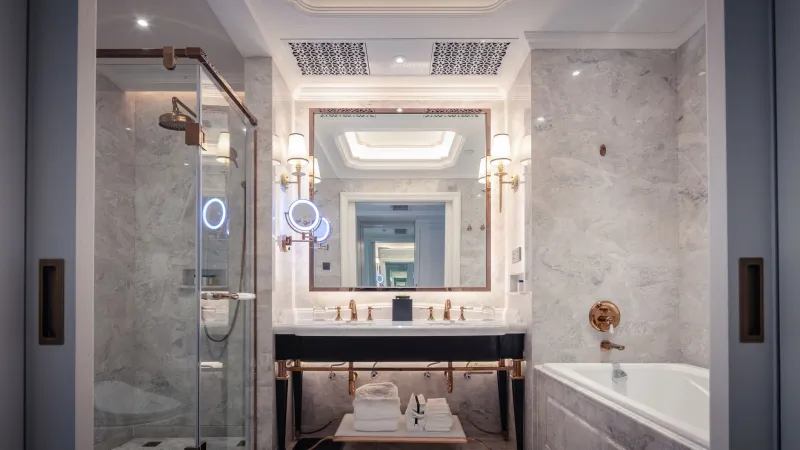
One of the most enduring and effective material combinations in contemporary luxury bathroom design is the pairing of a warm-toned metal with a cooler counterpart. Brushed brass or aged bronze alongside polished chrome or brushed nickel creates a tension that reads as sophisticated rather than confused — provided the pairing is applied with discipline.
Consider a bathroom in which a brushed brass freestanding tub filler and matching vanity faucets establish warmth as the dominant note. Introduce polished chrome in the shower system and the secondary mirror frame, and the result is a space that feels both grounded and refined. The cool metal prevents the brass from reading as overly traditional; the brass prevents the chrome from reading as sterile.
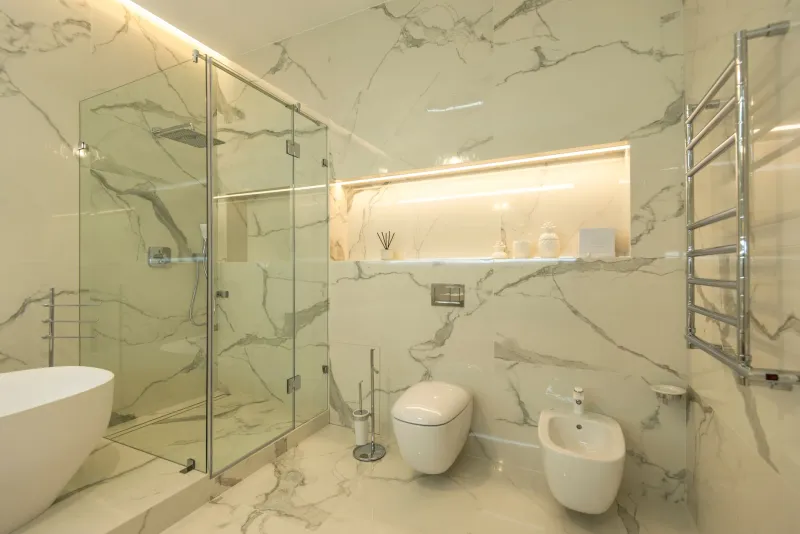
This same logic applies to surface materials. A honed Calacatta marble — with its warm ivory ground and soft gray veining — pairs beautifully with a cool, dark-veined quartzite on a feature wall. The contrast is present, but the shared stone language creates visual continuity.
Matte Finishes as a Unifying Agent
One of the most useful tools in the material-mixing toolkit is the strategic use of matte finishes. Matte black, in particular, has demonstrated remarkable staying power in American luxury bathroom design precisely because it reads as neutral in context. It does not compete with warm metals the way polished chrome might; it simply absorbs light and recedes.
Designers working on high-end residential projects in cities like New York, Los Angeles, and Chicago have increasingly used matte black as a grounding element — a finish that appears across multiple fixture tiers to create visual thread without drawing undue attention to itself. A matte black towel bar, cabinet hardware, and shower drain cover can tie together a bathroom that features both brushed brass and honed stone without any single element feeling out of place.
The key is consistency of application: once you introduce a matte finish as a connective element, it must appear at enough points in the room to register as intentional.
Texture as the Overlooked Variable
Most conversations about material mixing focus on color and sheen — the visible properties of metal finishes and stone surfaces. Texture, however, is an equally important dimension that is frequently underutilized.
A brushed finish differs from a hammered finish not only in appearance but in how it interacts with light. A fluted glass shower enclosure introduces a textural note that a clear panel does not. Handmade ceramic tile carries surface variation that factory-made porcelain lacks. These textural differences, when layered thoughtfully, add depth to a room without requiring additional colors or finishes.
In practice, this means that two fixtures in the same metal — say, a brushed brass faucet and a hammered brass vessel sink — can coexist without reading as redundant. The shared color creates cohesion; the textural contrast creates interest.
A Note on Restraint at the Tertiary Level
Perhaps the most common misstep in material-mixing projects is the introduction of a fourth or fifth finish at the tertiary fixture level. It is tempting, when selecting robe hooks or toilet paper holders, to treat these small accessories as low-stakes decisions. In reality, they are the finishing punctuation of the room's material narrative.
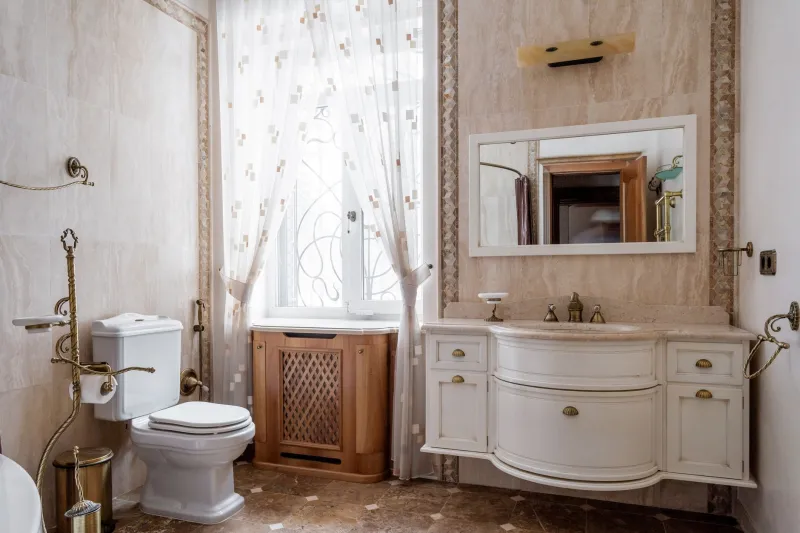
If your primary and secondary finishes are brushed brass and matte black, your tertiary fixtures should honor that vocabulary. A chrome robe hook introduced at this stage — even a high-quality one — will read as an oversight rather than a choice. The accumulated effect of multiple small deviations is a room that feels slightly unresolved, regardless of the quality of its principal fixtures.
Discipline at the tertiary level is what separates a bathroom that photographs beautifully from one that lives beautifully.
Designing for the Long View
Luxury bathroom renovations represent significant investments, and the most successful ones are those that remain visually compelling not just at installation but over years of daily use. A bathroom built around a thoughtfully constrained material palette — one in which every finish and texture has been chosen for its relationship to the whole — tends to age gracefully in a way that trend-driven designs do not.
The goal, ultimately, is a space that feels like it was designed rather than decorated. A room in which the materials tell a coherent story, where contrast creates energy rather than confusion, and where the discipline of limitation reveals itself as the highest form of design sophistication.