What Your Hands Already Know: The Case for Intentional Tactile Design in the Luxury Bathroom
There is a moment that every experienced bathroom designer knows well. A client walks into a finished space, pauses to take in the visual composition, and then—almost involuntarily—reaches out and touches the wall. They run a palm across the stone. They close a drawer. They lift a faucet handle. They are not checking for defects. They are confirming what their eyes have already suggested: that this space is real, considered, and worthy of trust.
Touch is the sense that ratifies all others. And yet, in the world of luxury bathroom design, it remains the most routinely neglected dimension of the sensory experience. Homeowners invest significantly in visual cohesion—coordinated finishes, harmonious palettes, precisely proportioned fixtures—while the tactile layer of the room is left largely to chance. The result is a space that photographs beautifully but fails to fully deliver on its promise the moment a hand makes contact with its surfaces.
At Seven Bathrooms, we have long observed that the finest spaces are those where every touchpoint—literal and figurative—has been designed with the same deliberateness as the visual plan. What follows is a considered examination of how tactile design works, where it is most frequently neglected, and how homeowners can bring genuine intentionality to the surfaces their hands encounter every day.
Why Touch Precedes Judgment
Neurologically, the sense of touch operates on a faster feedback loop than conscious visual analysis. Before the brain has fully processed what the eyes are seeing, the hands have already begun transmitting data about weight, temperature, texture, and resistance. In practical terms, this means that a bathroom can look extraordinary in photographs while feeling disappointing in person—and that feeling will color every subsequent interaction with the space.
Luxury, at its core, is a sensory proposition. It is the accumulated impression of quality delivered across multiple channels simultaneously. A space that succeeds visually but underperforms tactilely is, by definition, an incomplete luxury experience. The matte porcelain tile that looks stunning in a mood board but feels uncomfortably rough underfoot; the drawer pull that looks architectural but flexes slightly under pressure; the rain shower head that appears substantial but feels hollow when adjusted—these are the quiet failures that erode confidence in a space over time.
Flooring: The Foundation of Tactile Experience
The floor is where tactile design begins, because it is the surface with which the body has the most sustained and intimate contact. Bare feet on a cold tile floor at six in the morning is not a neutral experience—it is a statement about the values of the space.
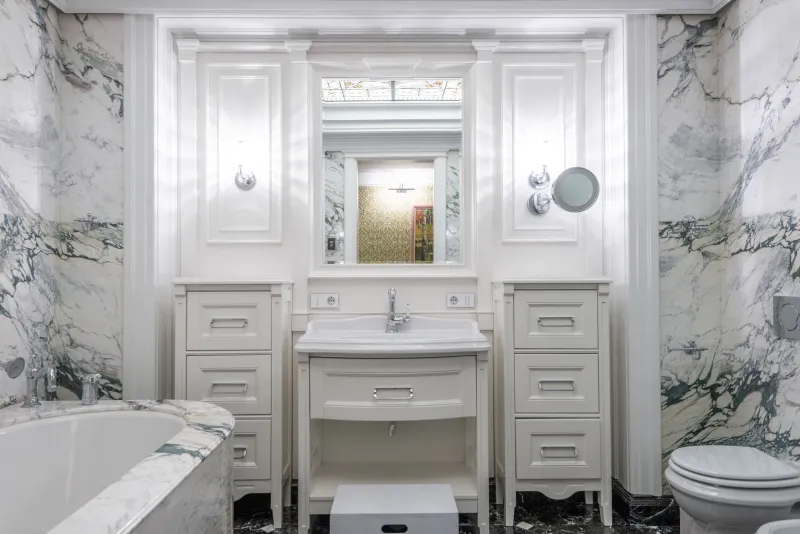
Material selection matters enormously here. Honed marble, for instance, offers a refined smoothness that feels substantively different from polished marble—warmer in perception, less clinical, more inviting to bare skin. Limestone carries a slight natural porosity that reads as organic and grounded. Large-format tiles minimize grout lines, which in turn minimizes the interrupted, grid-like sensation underfoot that can make even expensive tile feel utilitarian.
Texture, however, must be balanced against safety. The textured slip-resistance required in wet zones should be achieved through surface treatment rather than aggressive patterning. Micro-textured stone and lightly brushed concrete achieve grip without sacrificing the refined underfoot sensation that distinguishes a luxury bathroom from a functional one. Radiant floor heating—a feature now considered standard in high-end renovations—transforms this equation further, adding thermal comfort to the tactile calculus.
Wall Surfaces: The Overlooked Vertical Plane
Walls represent a vast tactile opportunity that most bathroom designs squander. The standard approach—smooth, glossy tile from floor to ceiling—is visually acceptable but tactilely inert. It communicates nothing. It offers no invitation to touch, no variation, no sense of material depth.
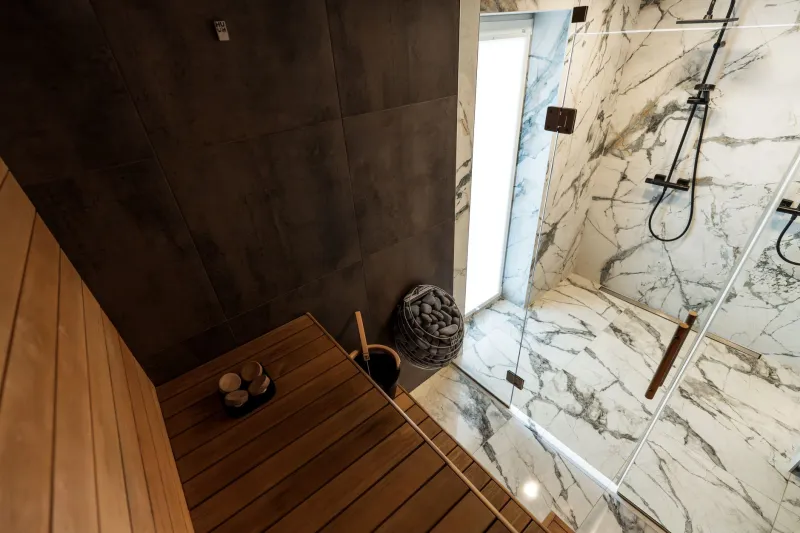
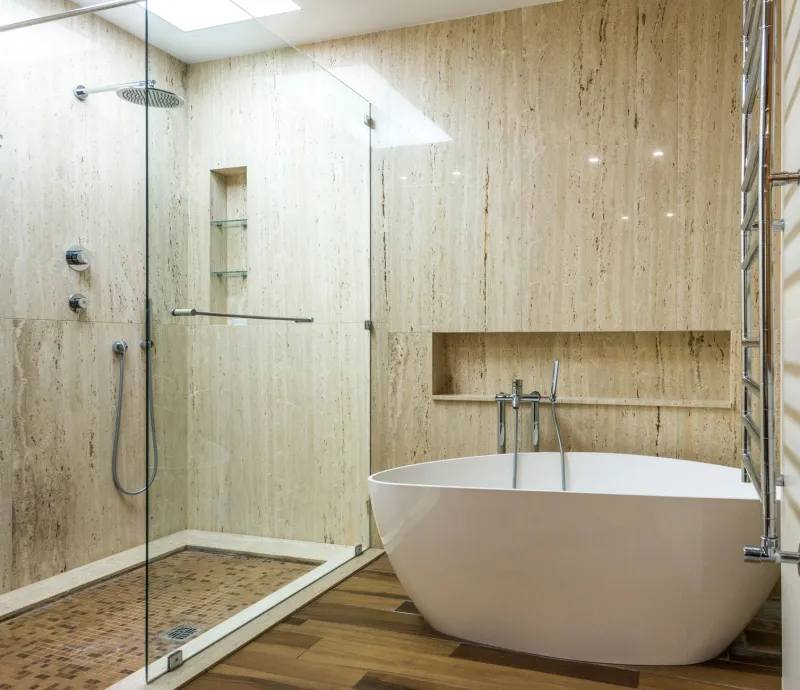
Textured wall treatments, by contrast, create what designers sometimes call a haptic narrative: a surface that rewards closer inspection and physical engagement. Fluted stone panels, for example, introduce a rhythmic verticality that is as satisfying to run a hand across as it is to observe. Venetian plaster, applied with traditional technique, produces a surface of subtle, layered depth that changes character depending on the angle of light and the pressure of touch. Brushed concrete panels bring an industrial refinement—cool, slightly rough, unmistakably material—that communicates authenticity in a way that smooth imitations never can.
For homeowners renovating existing bathrooms, a single textured accent wall—behind the freestanding tub, or flanking the vanity—can introduce meaningful tactile variation without requiring a full overhaul.
Fixtures: Where Touch Becomes Function
Faucets, handles, levers, and controls are the most frequently touched elements in any bathroom. They are also among the most revealing indicators of quality, because the hand is extraordinarily sensitive to the signals that distinguish a well-engineered fixture from a superficially similar one.
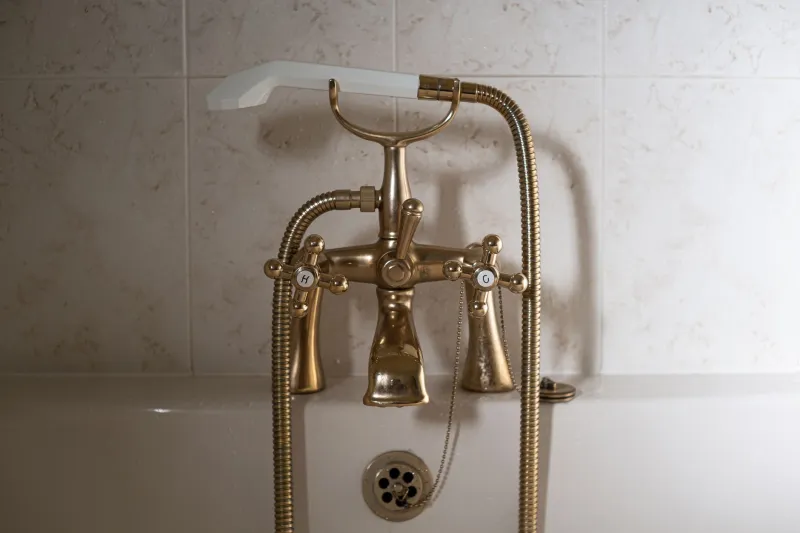
Weight is the first signal. A solid brass faucet body has a heft that communicates permanence. Zinc alloy alternatives—common in lower-tier fixtures regardless of their visual finish—feel light in a way that registers as insubstantial, even to users who could not name the material. Resistance and movement quality are equally telling: the smooth, dampened arc of a quality lever handle, the precise click of a thermostatic control, the firm but effortless turn of a well-machined valve—these are experiences that justify the price differential of premium hardware far more persuasively than any finish catalog.
Surface texture on fixtures matters as well. Knurled or ribbed grip sections on shower controls are not merely decorative; they communicate intentionality and provide genuine functional benefit in wet environments. Brushed and matte finishes—unlacquered brass, brushed nickel, matte black—engage the fingertip differently than high-polish alternatives, offering a tactile warmth that many homeowners find more satisfying over time.
Cabinetry and Hardware: The Daily Rituals
The vanity and its associated storage represent the most repetitive tactile interactions in the bathroom. Drawer pulls are handled dozens of times each day. Cabinet doors are pressed, pushed, and pulled in patterns so familiar they become unconscious. This frequency makes quality—or the lack of it—impossible to ignore.
Soft-close mechanisms are now expected at the luxury tier, but the quality of the mechanism matters. The deceleration curve of a premium soft-close drawer—the way it catches, slows, and settles with confident precision—is a tactile experience that communicates craftsmanship. Drawer box construction in solid wood or high-density material has a resonance and rigidity that composite alternatives cannot replicate. Even the slight give of an upholstered or leather-wrapped drawer front introduces a tactile register that distinguishes a bespoke piece from a production cabinet.
A Framework for Tactile Audit
For homeowners approaching a renovation—or evaluating an existing space—a simple tactile audit can be illuminating. Move through the bathroom as you would in daily use. Touch the walls. Walk barefoot. Open every drawer and cabinet. Turn every faucet. Close your eyes if it helps. Ask, at each point: does this feel like quality? Does it feel considered? Does the material communicate what it is, or does it apologize for what it is not?
The answers will identify the gaps. And in most luxury bathrooms, those gaps are not in the visual design. They are in the surfaces that the camera never captures—the ones that only the hand can read.
The Measure of a Finished Space
The finest luxury bathrooms are those that deliver on their promise at every point of contact. They are spaces where the visual design and the tactile experience are in complete agreement—where everything that looks refined also feels refined, and where the act of simply moving through the room produces a continuous, low-level pleasure that accumulates over time into something that feels, unmistakably, like quality.
That quality is not achieved by accident. It is the product of deliberate decisions about materials, surfaces, weights, and textures—decisions that require the same rigor and attention as the visual plan. When those decisions are made well, the result is a bathroom that does not merely impress. It convinces.