Smarter by Design: How Intelligent Mirror Technology Is Redefining the Luxury Bathroom
For most of the twentieth century, the bathroom mirror demanded very little of itself. It reflected. It endured. It occasionally fogged. Beyond those modest obligations, it contributed nothing to the experience of the room it inhabited. That era is, by any meaningful measure, over.
Across the upper tier of American residential design, the intelligent mirror has emerged as one of the most consequential fixtures in the contemporary bathroom. It is no longer a passive surface. It is a precision instrument — one that manages light, temperature, connectivity, and user experience with a sophistication that rivals any other element in the space. For homeowners who have invested in radiant floors, custom stone work, and bespoke cabinetry, the mirror is increasingly where the final, defining statement is made.
From Reflection to Interface
The shift began modestly. Early iterations of smart mirrors offered little more than embedded LED strips and rudimentary defogging pads — improvements over convention, certainly, but not transformations. What has changed in recent years is the depth of integration. Contemporary intelligent mirrors from manufacturers such as Robern, Electric Mirror, and Kohler's Verdera Voice series function less like upgraded looking glasses and more like ambient control centers embedded within an elegant frame.
Consider what a current flagship model might offer: full-spectrum LED lighting calibrated across a range of color temperatures, from warm incandescent tones suited to evening relaxation to crisp daylight-accurate illumination designed for grooming precision. Bluetooth audio. A built-in voice assistant capable of managing smart home systems, reading morning schedules aloud, or adjusting the thermostat without the user ever touching a screen. Some models incorporate display technology that overlays weather data, calendar appointments, or news headlines directly onto the mirror surface — information that disappears the moment you step away, leaving only your reflection.
These are not novelties. They are, for a growing segment of affluent American homeowners, baseline expectations.
The Defogging Imperative
Of all the functional advances embedded in modern luxury mirrors, heated glass technology may be the most immediately transformative in daily use. The experience of stepping from a steam shower to find a perfectly clear mirror — no waiting, no wiping, no gradual emergence of one's reflection through dissipating condensation — is one of those quiet pleasures that, once experienced, renders the alternative genuinely intolerable.
Heated mirror systems typically employ a thin resistive element laminated behind the glass surface, maintaining a temperature just above the ambient dew point. The result is continuous clarity regardless of steam levels in the room. For bathrooms designed around spa-like shower enclosures, soaking tubs, or steam rooms, this feature is no longer a premium add-on. It is an architectural necessity.
From a design standpoint, the technology is entirely invisible. The mirror looks exactly as a mirror should — flush, polished, uninterrupted. The intelligence is embedded, not announced.
Light as a Design Tool
Perhaps the most underappreciated dimension of intelligent mirror design is its relationship to light. The bathroom is a space where lighting quality has an outsized impact on lived experience, and the mirror — positioned at eye level, directly adjacent to the face — is the single most influential light source in any grooming environment.
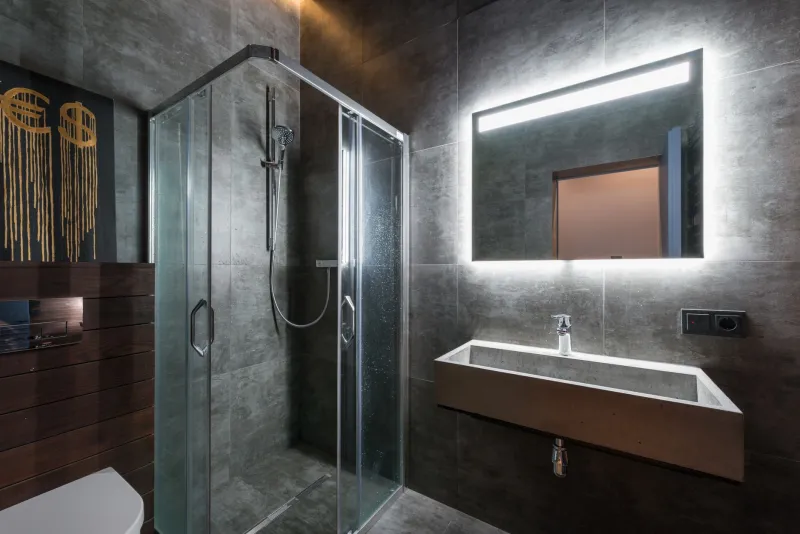
Traditional vanity lighting, mounted above or to the sides of a conventional mirror, creates shadows and inconsistencies that are neither flattering nor functional. Integrated LED systems built directly into the mirror's perimeter or diffused through its surface address this problem with precision. Edge-lit mirrors distribute illumination evenly across the face, eliminating the harsh contrasts that overhead fixtures produce. Backlit designs introduce a softer ambient glow that enhances the perceived depth of the room.
More sophisticated systems allow the user to adjust color temperature dynamically — a feature that is particularly valuable in bathrooms used across different times of day and for different purposes. The same mirror that provides accurate, neutral light for morning grooming can shift to a warmer, lower-intensity setting in the evening, supporting the body's natural transition toward rest. This kind of adaptive illumination represents a meaningful convergence of wellness design and technical capability.
Voice Control and the Frictionless Bathroom
The integration of voice control into bathroom mirrors speaks to a broader aspiration in luxury residential design: the elimination of unnecessary friction from daily rituals. The bathroom, particularly in the morning, is a space where attention is divided and hands are often occupied. A mirror that responds to spoken commands — adjusting lighting, playing music, providing a weather briefing, or relaying messages — addresses that context directly.
Kohler's partnership with Amazon Alexa and Google Assistant has brought this capability into the mainstream luxury market, while brands like Séura have developed proprietary interfaces tailored specifically to bathroom environments. Waterproofing standards, speaker placement, and microphone sensitivity are all engineered with the humid, acoustically complex bathroom in mind — a level of contextual design that distinguishes purpose-built bathroom mirrors from repurposed consumer electronics.
For homeowners who have already invested in integrated smart home systems — controlling shades, climate, security, and entertainment from a unified platform — the intelligent mirror represents a natural and aesthetically coherent extension of that infrastructure into the bathroom.
The Aesthetic Argument
It would be a mistake to discuss intelligent mirrors solely through the lens of technology. The finest examples on the market succeed precisely because their intelligence does not compromise their elegance. A mirror that bristles with visible components, indicator lights, or conspicuous bezels fails the fundamental test of luxury design: the experience of refinement without the evidence of effort.
The best intelligent mirrors achieve a kind of visual restraint that belies their complexity. Frameless designs with beveled edges. Anti-reflective coatings that enhance depth and clarity. Touch-sensitive controls that are flush with the glass and invisible when not in use. The technology recedes; the mirror itself — its proportions, its surface quality, its relationship to the vanity and the surrounding materials — takes precedence.
This is where the intelligent mirror diverges most sharply from the novelty gadget category it is sometimes mistakenly placed in. A gadget announces itself. A luxury fixture disappears into the design, contributing to the whole without demanding attention. The best smart mirrors accomplish exactly that.
What to Consider Before Specifying
For homeowners and designers approaching a bathroom renovation or new build, several considerations should guide mirror selection. Size and proportion relative to the vanity are paramount — an intelligent mirror that is technically impressive but visually mismatched undermines the coherence of the entire space. Electrical requirements, particularly for heated glass and integrated audio, should be addressed during the rough-in phase rather than retrofitted.
Warranty terms and manufacturer support also merit scrutiny. Unlike a conventional mirror, an intelligent fixture contains components that require servicing. Understanding the brand's track record for longevity and after-sale support is a reasonable part of the specification process.
Finally, consider the mirror in the context of the room's overall technology ecosystem. A mirror with voice assistant integration is most valuable when it can communicate with the home's broader smart systems. Selecting fixtures that share compatible platforms — or that operate on open standards — will determine whether the mirror functions as a seamlessly integrated element or an isolated feature.
The Mirror as Measure
The intelligent mirror has arrived at a particular moment in luxury bathroom design — one in which the conversation has moved decisively beyond materials and finishes toward experience and intelligence. Affluent American homeowners are no longer satisfied by a bathroom that looks exceptional. They expect one that performs exceptionally, in ways that are felt rather than seen.
The mirror, positioned at the center of the daily ritual, at eye level, at the intersection of light and reflection and personal attention, is the ideal vehicle for that ambition. When it is done well, it elevates every moment spent before it. When it is done brilliantly, you barely notice it at all — which is, in luxury design, precisely the point.