Rooted in Calm: The Case for Biophilic Design in the Modern Luxury Bathroom
For most of the twentieth century, the aspirational bathroom was defined by its distance from nature. Gleaming porcelain, chrome hardware, and perfectly uniform tile communicated cleanliness through sterility. The implicit message was that a well-appointed bathroom was, above all, controlled—a space where organic unpredictability had no place.
That orthodoxy is dissolving. Across high-end residential projects from coastal California to Manhattan's Upper West Side, designers and their clients are deliberately reintroducing the natural world into the bathroom—not as a stylistic affectation, but as a considered response to what environmental psychology has been demonstrating for decades: proximity to nature measurably reduces stress, lowers cortisol levels, and accelerates cognitive recovery. When applied with precision to a space already devoted to personal restoration, biophilic design principles do not merely beautify a bathroom. They fundamentally alter how it feels to exist within it.
What Biophilia Actually Means in a Designed Space
The term biophilia—literally, "love of living things"—was popularized by biologist E.O. Wilson in the 1980s to describe the innate human affinity for other living systems. In design, the concept has evolved into a rigorous framework with identifiable categories: direct nature (live plants, water features, natural light), indirect nature (natural materials, organic patterns, botanical imagery), and spatial conditions that mimic natural environments, such as prospect-and-refuge arrangements that offer both openness and enclosure.
A genuinely biophilic bathroom engages all three categories. It is not sufficient to place a potted fern on a shelf and consider the work done. The most effective applications layer natural stone underfoot, introduce living greenery at eye level, allow daylight to shift across surfaces throughout the day, and frame views—however modest—of an exterior landscape. Each element reinforces the others, building an experiential depth that synthetic materials, however beautiful, cannot replicate.
The Living Layer: Plants Chosen for Humid Environments
The bathroom's warm, moisture-rich microclimate is, counterintuitively, one of the most hospitable environments in the home for a specific category of tropical plants. Species such as pothos, peace lily, bird of paradise, and various ferns evolved in high-humidity conditions and require comparatively little direct sunlight—making them practical choices even for bathrooms with limited window exposure.
In luxury applications, the approach extends well beyond potted specimens on a windowsill. Integrated planting niches—recessed into shower walls or built into freestanding room dividers—allow vegetation to become architectural. Moss walls, sealed behind glass or left open to the room's humidity, introduce living texture without the maintenance demands of rooted plants. Vertical garden installations, increasingly available through specialty landscape designers who work alongside interior architects, can transform an unused bathroom wall into a dense, breathing surface that changes subtly with the seasons.
The psychological effect is immediate and well-documented. Research published in the Journal of Physiological Anthropology found that active interaction with indoor plants—including simply being in their presence—suppresses autonomic nervous system activity associated with stress. In a bathroom designed for morning preparation and evening decompression, that suppression is not incidental. It is the entire point.
Stone as Narrative: Moving Beyond the Uniform Slab
Natural stone has long been a signifier of luxury in bathroom design, but biophilic application asks something more of it than surface opulence. The distinction lies in selection and placement. A stone chosen for its biophilic contribution is chosen for the story its veining tells—the geological record embedded in each slab—rather than simply for its cost per square foot.
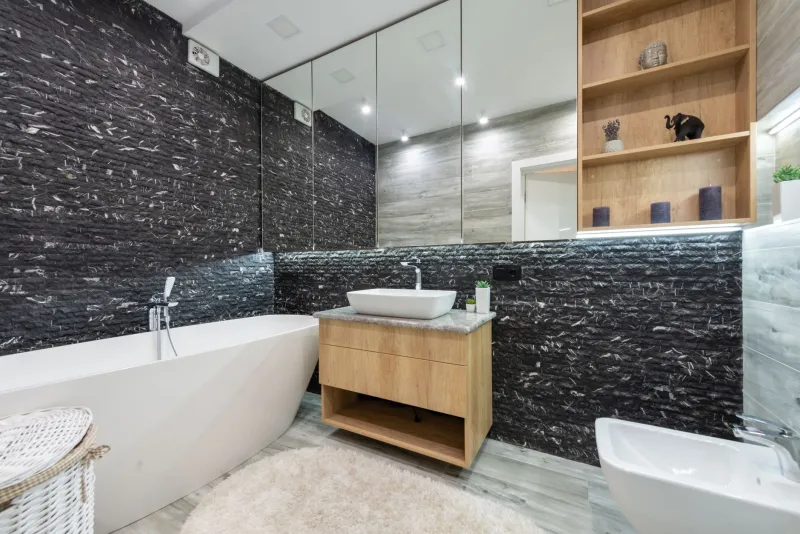
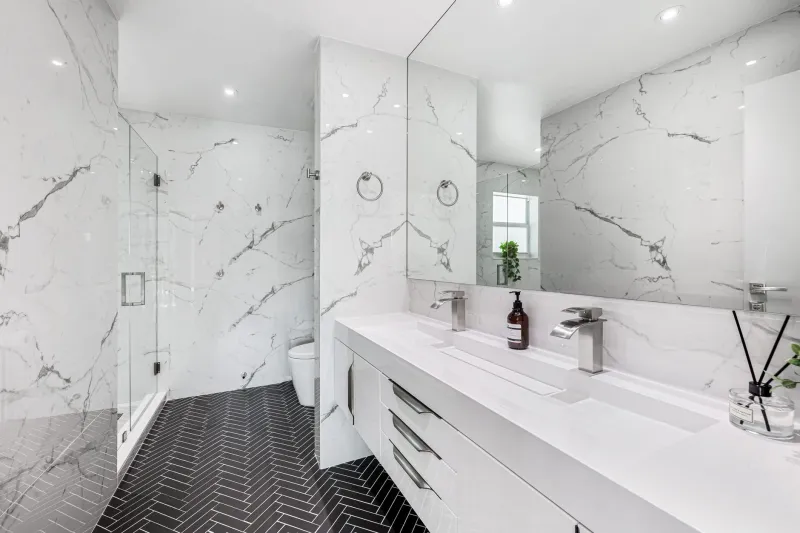
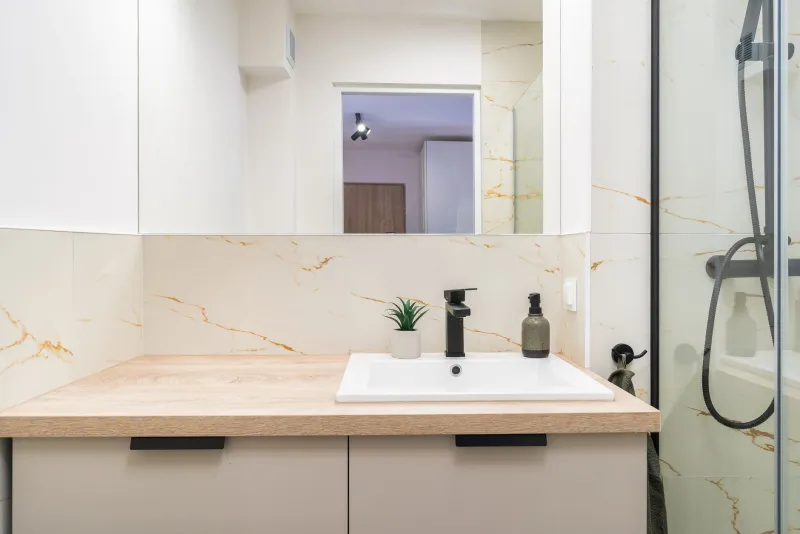
Bookmatched marble that opens like a landscape across a feature wall, quartzite with iron-oxide inclusions that suggest a winter forest floor, travertine with its fossilized voids and warm ochre tones: these materials invite sustained visual attention in a way that engineered quartz, however technically impressive, does not. The eye follows the movement in the stone, tracing patterns that were not manufactured to any specification. That unpredictability is not a flaw. It is the source of the material's psychological richness.
Designers working within a biophilic framework also consider how stone responds to light across the course of a day. A honed limestone surface that appears pale and cool under morning light will warm considerably under the amber tones of evening illumination—a natural variability that reinforces the sense of a space connected to external rhythms rather than sealed against them.
Wood in Wet Spaces: Thermal Mass and Sensory Warmth
The inclusion of wood in a bathroom has historically required careful qualification. Moisture, temperature fluctuation, and direct water contact place significant demands on any organic material. However, advances in hardwood treatment, teak's natural oil content, and the growing availability of thermally modified lumber have made wood a genuinely viable—and deeply effective—biophilic element in even the most demanding wet-room configurations.
Teak shower benches and slatted flooring inserts are among the most established applications, prized for their tactile warmth and their visual contrast against stone or large-format tile. More ambitious installations incorporate wood-paneled accent walls in dry zones adjacent to the shower, floating vanity bases in oiled walnut or white oak, and custom cabinetry that brings the material's grain and warmth into the room's dominant visual field.
Beyond aesthetics, wood contributes a thermal quality that stone and tile cannot provide. Bare feet on a teak mat register a fundamentally different sensory experience than the same feet on polished marble—a distinction that matters considerably at six in the morning. Biophilic design recognizes that the body's encounter with natural materials is not merely visual, and that a bathroom's success is ultimately measured in how it feels to inhabit, not only how it photographs.
Light, Water, and the Rhythm of the Natural World
Two elements unite virtually every successful biophilic bathroom: the deliberate management of natural light and the considered presence of water beyond the purely functional.
Daylight in a bathroom is not simply a matter of brightness. Its quality—the color temperature of morning sun versus late afternoon, the diffusion of light through frosted glass, the dappled effect of a nearby tree—communicates time and place in ways that artificial lighting, however sophisticated, approximates rather than replicates. Skylights positioned above soaking tubs have become a defining feature of high-end bathroom design precisely because they reconnect the bathing experience to the sky above. The water in the tub reflects that light, and the room becomes, briefly, a space in genuine dialogue with the exterior world.
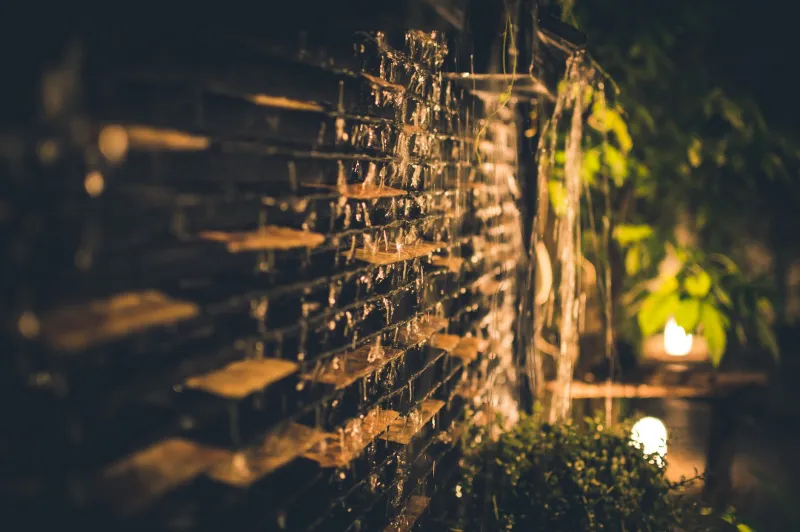
Water features within the bathroom—rainfall showerheads, freestanding soaking tubs with overflow channels, even small recirculating fountains in adjacent dressing areas—extend this principle. The sound of moving water is among the most reliably restorative acoustic environments identified by researchers studying attention restoration theory. Its presence in a bathroom is therefore not decorative excess. It is an evidence-based design decision.
Designing the Biophilic Bathroom With Intention
The risk in any design trend is superficial adoption—the equivalent of installing a single succulent and declaring a philosophy realized. Biophilic design, applied with genuine rigor, requires that every material decision, every lighting choice, and every spatial proportion be evaluated against the question of whether it deepens or diminishes the occupant's felt connection to the natural world.
For homeowners undertaking a luxury bathroom renovation, the most productive first step is a candid conversation with a designer experienced in biophilic principles—one who understands not only which materials qualify as natural, but how those materials interact with light, humidity, and each other over time. The goal is not a bathroom that resembles a greenhouse. It is a bathroom that, through carefully composed layers of stone, wood, living plant life, and considered light, produces in its occupant the unmistakable sensation of having, for a few minutes each day, come home to something older and quieter than the built world outside its door.